|
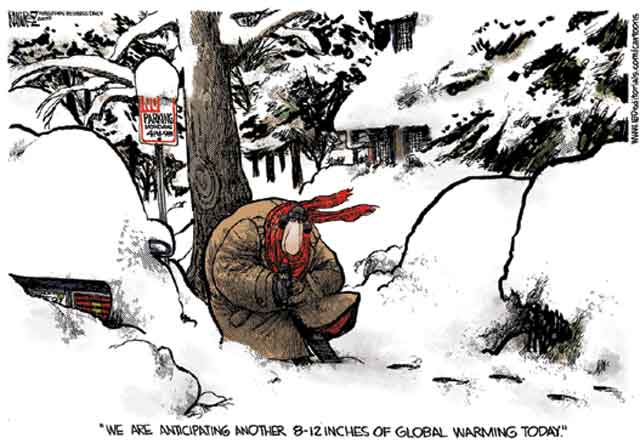
Fact The climate seems to be becoming warmer.
Belief If developed countries reduce their emissions of carbon dioxide, then the climate will become significantly less warm than it will otherwise become.
Evidence supporting this BELIEF can be found at:
Arguments against this belief can be found at: Skeptic's Guide to Debunking Global Warming SPPI -- Science and Public Policy Institute Heartland Institute -- Global Warming Facts
Federal legislation pandering to the fears of Global Warming Believers might be in violation of the First Amendment to the Constitution which states that, "Congress shall make no law respecting an establishment of religion".
The conclusion of the late climate scientist Roger Revelle—Al Gore's supposed mentor—is worth pondering: the evidence for global warming thus far doesn't warrant any action unless it is justifiable on grounds that have nothing to do with climate.
The Deniers of the Environmentalist Beliefs
Ocean Cooling to
Briefly Halt Global Warming, Researchers Say
Posted: Thursday, April 30, 2008 April 30 (Bloomberg) --
Parts of North America and Europe may cool naturally over the next
decade, as shifting ocean currents temporarily blunt the global-warming
effect caused by mankind, Germany's Leibniz Institute of Marine Sciences
said.
Global Temperatures 'To Decrease' By Roger Harrabin, BBC News Environment Analyst
Posted:
Friday, April 4, 2008 La Nina Key Facts: = Refers to the extensive cooling of the central and eastern Pacific = Increased sea temperatures on the western side of the Pacific mean the atmosphere has more energy and frequency of heavy rain and thunderstorms is increased =
Typically lasts for up to 12 months and
generally less damaging event than the stronger El Nino
Climate Facts To Warm
To
Posted: Saturday, March 22, 2008
Climate panel on the hot seatBy H. Sterling Burnett in The Washington Times Posted: Friday, March 14, 2008 More than 20 years ago, climate scientists began to raise alarms over the possibility global temperatures were rising due to human activities, such as deforestation and the burning of fossil fuels. To better understand this potential threat, the World Meteorological Organization and the United Nations created the Intergovernmental Panel on Climate Change (IPCC) in 1988 to provide a "comprehensive, objective, scientific, technical and socioeconomic assessment of human-caused climate change, its potential impacts and options for adaptation and mitigation." IPCC reports have predicted average world temperatures will increase dramatically, leading to the spread of tropical diseases, severe drought, the rapid melting of the world's glaciers and ice caps, and rising sea levels. However, several assessments of the IPCC's work have shown the techniques and methods used to derive its climate predictions are fundamentally flawed. In a 2001 report, the IPCC published an image commonly referred to as the "hockey stick." This graph showed relatively stable temperatures from A.D. 1000 to 1900, with temperatures rising steeply from 1900 to 2000. The IPCC and public figures, such as former Vice President Al Gore, have used the hockey stick to support the conclusion that human energy use over the last 100 years has caused unprecedented rise global warming. However, several studies cast doubt on the accuracy of the hockey stick, and in 2006 Congress requested an independent analysis of it. A panel of statisticians chaired by Edward J. Wegman, of George Mason University, found significant problems with the methods of statistical analysis used by the researchers and with the IPCC's peer review process. For example, the researchers who created the hockey stick used the wrong time scale to establish the mean temperature to compare with recorded temperatures of the last century. Because the mean temperature was low, the recent temperature rise seemed unusual and dramatic. This error was not discovered in part because statisticians were never consulted. Furthermore, the community of specialists in ancient climates from which the peer reviewers were drawn was small and many of them had ties to the original authors — 43 paleoclimatologists had previously coauthored papers with the lead researcher who constructed the hockey stick. These problems led Mr. Wegman's team to conclude that the idea that the planet is experiencing unprecedented global warming "cannot be supported." The IPCC published its Fourth Assessment Report in 2007 predicting global warming will lead to widespread catastrophe if not mitigated, yet failed to provide the most basic requirement for effective climate policy: accurate temperature statistics. A number of weaknesses in the measurements include the fact temperatures aren't recorded from large areas of the Earth's surface and many weather stations once in undeveloped areas are now surrounded by buildings, parking lots and other heat-trapping structures resulting in an urban-heat-island effect. Even using accurate temperature data, sound forecasting methods are required to predict climate change. Over time, forecasting researchers have compiled 140 principles that can be applied to a broad range of disciplines, including science, sociology, economics and politics. In a recent NCPA study, Kesten Green and J. Scott Armstrong used these principles to audit the climate forecasts in the Fourth Assessment Report. Messrs. Green and Armstrong found the IPCC clearly violated 60 of the 127 principles relevant in assessing the IPCC predictions. Indeed, it could only be clearly established that the IPCC followed 17 of the more than 127 forecasting principles critical to making sound predictions. A good example of a principle clearly violated is "Make sure forecasts are independent of politics." Politics shapes the IPCC from beginning to end. Legislators, policymakers and/or diplomatic appointees select (or approve) the scientists — at least the lead scientists — who make up the IPCC. In addition, the summary and the final draft of the IPCC's Fourth Assessment Report was written in collaboration with political appointees and subject to their approval. Sadly, Mr. Green and Mr. Armstrong found no evidence the IPCC was even aware of the vast literature on scientific forecasting methods, much less applied the principles. The IPCC and its defenders often argue that critics who are not climate scientists are unqualified to judge the validity of their work. However, climate predictions rely on methods, data and evidence from other fields of expertise, including statistical analysis and forecasting. Thus, the work of the IPCC is open to analysis and criticism from other disciplines. The IPCC's policy recommendations are based on flawed statistical analyses and procedures that violate general forecasting principles. Policymakers should take this into account before enacting laws to counter global warming — which economists point out would have severe economic consequences. H. Sterling Burnett is a senior fellow with the National Center for Policy Analysis, a nonpartisan, nonprofit research institute in Dallas.
The Sun Also Sets By Investors Business Daily
Posted: Thursday, February 07, 2008
A Cold Spell Soon To Replace Global Warming
By Oleg Sorokhtin for RIA Novosti
Published: Wednesday, January 1, 2008
Dr. Oleg Sorokhtin, Merited Scientist of Russia and fellow of the
Russian Academy of Natural Sciences, is staff researcher of the
Oceanology Institute.
U.S. Senate Report: Over 400 Prominent Scientists Disputed Man-Made Global Warming Claims in 2007
Senate Report Debunks "Consensus"
Thursday, 20 December, 2007 By Marc Morano - Marc_Morano@EPW.Senate.Gov
Complete U.S. Senate Report Now Available: (LINK)
Complete Report without Introduction: ( LINK)
INTRODUCTION: Over 400 prominent scientists from more than two dozen countries recently voiced significant objections to major aspects of the so-called "consensus" on man-made global warming. These scientists, many of whom are current and former participants in the UN IPCC (Intergovernmental Panel on Climate Change), criticized the climate claims made by the UN IPCC and former Vice President Al Gore.
The new report issued by the Senate Environment and Public Works Committee’s office of the GOP Ranking Member details the views of the scientists, the overwhelming majority of whom spoke out in 2007.
Even some in the establishment media now appear to be taking notice of the growing number of skeptical scientists. In October, the Washington Post Staff Writer Juliet Eilperin conceded the obvious, writing that climate skeptics "appear to be expanding rather than shrinking." Many scientists from around the world have dubbed 2007 as the year man-made global warming fears “bite the dust.” (LINK) In addition, many scientists who are also progressive environmentalists believe climate fear promotion has "co-opted" the green movement. (LINK)
This blockbuster Senate report lists the scientists by name, country of residence, and academic/institutional affiliation. It also features their own words, biographies, and weblinks to their peer reviewed studies and original source materials as gathered from public statements, various news outlets, and websites in 2007. This new “consensus busters” report is poised to redefine the debate.
Many of the scientists featured in this report consistently stated that numerous colleagues shared their views, but they will not speak out publicly for fear of retribution. Atmospheric scientist Dr. Nathan Paldor, Professor of Dynamical Meteorology and Physical Oceanography at the Hebrew University of Jerusalem, author of almost 70 peer-reviewed studies, explains how many of his fellow scientists have been intimidated.
“Many of my colleagues with whom I spoke share these views and report on their inability to publish their skepticism in the scientific or public media,” Paldor wrote. [Note: See also July 2007 Senate report detailing how skeptical scientists have faced threats and intimidation - LINK ]
Scientists from Around the World Dissent
This new report details how teams of international scientists are dissenting from the UN IPCC’s view of climate science. In such nations as Germany, Brazil, the Netherlands, Russia, New Zealand and France, nations, scientists banded together in 2007 to oppose climate alarmism. In addition, over 100 prominent international scientists sent an open letter in December 2007 to the UN stating attempts to control climate were “futile.” (LINK)
Paleoclimatologist Dr. Tim Patterson, professor in the department of Earth Sciences at Carleton University in Ottawa, recently converted from a believer in man-made climate change to a skeptic. Patterson noted that the notion of a “consensus” of scientists aligned with the UN IPCC or former Vice President Al Gore is false. “I was at the Geological Society of America meeting in Philadelphia in the fall and I would say that people with my opinion were probably in the majority.”
This new committee report, a first of its kind, comes after the UN IPCC chairman Rajendra Pachauri implied that there were only “about half a dozen” skeptical scientists left in the world. (LINK) Former Vice President Gore has claimed that scientists skeptical of climate change are akin to “flat Earth society members” and similar in number to those who “believe the moon landing was actually staged in a movie lot in Arizona.” (LINK) & (LINK)
The distinguished scientists featured in this new report are experts in diverse fields, including: climatology; oceanography; geology; biology; glaciology; biogeography; meteorology; oceanography; economics; chemistry; mathematics; environmental sciences; engineering; physics and paleoclimatology. Some of those profiled have won Nobel Prizes for their outstanding contribution to their field of expertise and many shared a portion of the UN IPCC Nobel Peace Prize with Vice President Gore.
Additionally, these scientists hail from prestigious institutions worldwide, including: Harvard University; NASA; National Oceanic and Atmospheric Administration (NOAA) and the National Center for Atmospheric Research (NCAR); Massachusetts Institute of Technology; the UN IPCC; the Danish National Space Center; U.S. Department of Energy; Princeton University; the Environmental Protection Agency; University of Pennsylvania; Hebrew University of Jerusalem; the International Arctic Research Centre; the Pasteur Institute in Paris; the Belgian Weather Institute; Royal Netherlands Meteorological Institute; the University of Helsinki; the National Academy of Sciences of the U.S., France, and Russia; the University of Pretoria; University of Notre Dame; Stockholm University; University of Melbourne; University of Columbia; the World Federation of Scientists; and the University of London.
The voices of many of these hundreds of scientists serve as a direct challenge to the often media-hyped “consensus” that the debate is “settled.”
A May 2007 Senate report detailed scientists who had recently converted from believers in man-made global warming to skepticism. [See May 15, 2007 report: Climate Momentum Shifting: Prominent Scientists Reverse Belief in Man-made Global Warming - Now Skeptics: Growing Number of Scientists Convert to Skeptics After Reviewing New Research – (LINK) ]
The report counters the claims made by the promoters of man-made global warming fears that the number of skeptical scientists is dwindling.
Examples of “consensus” claims made by promoters of man-made climate fears:
Former Vice President Al Gore (November 5, 2007): “There are still people who believe that the Earth is flat.” (LINK) Gore also compared global warming skeptics to people who 'believe the moon landing was actually staged in a movie lot in Arizona' (June 20, 2006 - LINK)
CNN’s Miles O’Brien (July 23, 2007): The scientific debate is over.” “We're done." O’Brien also declared on CNN on February 9, 2006 that scientific skeptics of man-made catastrophic global warming “are bought and paid for by the fossil fuel industry, usually.” (LINK)
On July 27, 2006, Associated Press reporter Seth Borenstein described a scientist as “one of the few remaining scientists skeptical of the global warming harm caused by industries that burn fossil fuels.” (LINK)
Dr. Rajendra Pachauri, Chairman of the IPCC view on the number of skeptical scientists as quoted on Feb. 20, 2003: “About 300 years ago, a Flat Earth Society was founded by those who did not believe the world was round. That society still exists; it probably has about a dozen members.” (LINK)
Agence France-Press (AFP Press) article (December 4, 2007): The article noted that a prominent skeptic “finds himself increasingly alone in his claim that climate change poses no imminent threat to the planet.”
Andrew Dessler in the eco-publication Grist Magazine (November 21, 2007): “While some people claim there are lots of skeptical climate scientists out there, if you actually try to find one, you keep turning up the same two dozen or so (e.g., Singer, Lindzen, Michaels, Christy, etc., etc.). These skeptics are endlessly recycled by the denial machine, so someone not paying close attention might think there are lots of them out there -- but that's not the case. (LINK)
The Washington Post asserted on May 23, 2006 that there were only “a handful of skeptics” of man-made climate fears. (LINK)
ABC News Global Warming Reporter Bill Blakemore reported on August 30, 2006: “After extensive searches, ABC News has found no such [scientific] debate” on global warming. (LINK)
# #
Brief highlights of the report featuring over 400 international scientists:
Israel: Dr. Nathan Paldor, Professor of Dynamical Meteorology and Physical Oceanography at the Hebrew University of Jerusalem has authored almost 70 peer-reviewed studies and won several awards. “First, temperature changes, as well as rates of temperature changes (both increase and decrease) of magnitudes similar to that reported by IPCC to have occurred since the Industrial revolution (about 0.8C in 150 years or even 0.4C in the last 35 years) have occurred in Earth's climatic history. There's nothing special about the recent rise!”
Russia: Russian scientist Dr. Oleg Sorochtin of the Institute of Oceanology at the Russian Academy of Sciences has authored more than 300 studies, nine books, and a 2006 paper titled “The Evolution and the Prediction of Global Climate Changes on Earth.” “Even if the concentration of ‘greenhouse gases’ double man would not perceive the temperature impact,” Sorochtin wrote.
Spain: Anton Uriarte, a professor of Physical Geography at the University of the Basque Country in Spain and author of a book on the paleoclimate, rejected man-made climate fears in 2007. “There's no need to be worried. It's very interesting to study [climate change], but there's no need to be worried,” Uriate wrote.
Netherlands: Atmospheric scientist Dr. Hendrik Tennekes, a scientific pioneer in the development of numerical weather prediction and former director of research at The Netherlands' Royal National Meteorological Institute, and an internationally recognized expert in atmospheric boundary layer processes, “I find the Doomsday picture Al Gore is painting – a six-meter sea level rise, fifteen times the IPCC number – entirely without merit,” Tennekes wrote. “I protest vigorously the idea that the climate reacts like a home heating system to a changed setting of the thermostat: just turn the dial, and the desired temperature will soon be reached."
Brazil: Chief Meteorologist Eugenio Hackbart of the MetSul Meteorologia Weather Center in Sao Leopoldo – Rio Grande do Sul, Brazil declared himself a skeptic. “The media is promoting an unprecedented hyping related to global warming. The media and many scientists are ignoring very important facts that point to a natural variation in the climate system as the cause of the recent global warming,” Hackbart wrote on May 30, 2007.
France: Climatologist Dr. Marcel Leroux, former professor at Université Jean Moulin and director of the Laboratory of Climatology, Risks, and Environment in Lyon, is a climate skeptic. Leroux wrote a 2005 book titled Global Warming – Myth or Reality? - The Erring Ways of Climatology. “Day after day, the same mantra - that ‘the Earth is warming up’ - is churned out in all its forms. As ‘the ice melts’ and ‘sea level rises,’ the Apocalypse looms ever nearer! Without realizing it, or perhaps without wishing to, the average citizen in bamboozled, lobotomized, lulled into mindless acceptance. ... Non-believers in the greenhouse scenario are in the position of those long ago who doubted the existence of God ... fortunately for them, the Inquisition is no longer with us!”
Norway: Geologist/Geochemist Dr. Tom V. Segalstad, a professor and head of the Geological Museum at the University of Oslo and formerly an expert reviewer with the UN IPCC: “It is a search for a mythical CO2 sink to explain an immeasurable CO2 lifetime to fit a hypothetical CO2 computer model that purports to show that an impossible amount of fossil fuel burning is heating the atmosphere. It is all a fiction.”
Finland: Dr. Boris Winterhalter, retired Senior Marine Researcher of the Geological Survey of Finland and former professor of marine geology at University of Helsinki, criticized the media for what he considered its alarming climate coverage. “The effect of solar winds on cosmic radiation has just recently been established and, furthermore, there seems to be a good correlation between cloudiness and variations in the intensity of cosmic radiation. Here we have a mechanism which is a far better explanation to variations in global climate than the attempts by IPCC to blame it all on anthropogenic input of greenhouse gases. “
Germany: Paleoclimate expert Augusto Mangini of the University of Heidelberg in Germany, criticized the UN IPCC summary. “I consider the part of the IPCC report, which I can really judge as an expert, i.e. the reconstruction of the paleoclimate, wrong,” Mangini noted in an April 5, 2007 article. He added: “The earth will not die.”
Canada: IPCC 2007 Expert Reviewer Madhav Khandekar, a Ph.D meteorologist, a scientist with the Natural Resources Stewardship Project who has over 45 years experience in climatology, meteorology and oceanography, and who has published nearly 100 papers, reports, book reviews and a book on Ocean Wave Analysis and Modeling: “To my dismay, IPCC authors ignored all my comments and suggestions for major changes in the FOD (First Order Draft) and sent me the SOD (Second Order Draft) with essentially the same text as the FOD. None of the authors of the chapter bothered to directly communicate with me (or with other expert reviewers with whom I communicate on a regular basis) on many issues that were raised in my review. This is not an acceptable scientific review process.”
Czech Republic: Czech-born U.S. climatologist Dr. George Kukla, a research scientist with the Lamont-Doherty Earth Observatory at University of Columbia expressed climate skepticism in 2007. “The only thing to worry about is the damage that can be done by worrying. Why are some scientists worried? Perhaps because they feel that to stop worrying may mean to stop being paid,” Kukla told Gelf Magazine on April 24, 2007.
India: One of India's leading geologists, B.P. Radhakrishna, President of the Geological Society of India, expressed climate skepticism in 2007. “We appear to be overplaying this global warming issue as global warming is nothing new. It has happened in the past, not once but several times, giving rise to glacial-interglacial cycles.”
USA: Climatologist Robert Durrenberger, past president of the American Association of State Climatologists, and one of the climatologists who gathered at Woods Hole to review the National Climate Program Plan in July, 1979: “Al Gore brought me back to the battle and prompted me to do renewed research in the field of climatology. And because of all the misinformation that Gore and his army have been spreading about climate change I have decided that ‘real’ climatologists should try to help the public understand the nature of the problem.”
Italy: Internationally renowned scientist Dr. Antonio Zichichi, president of the World Federation of Scientists and a retired Professor of Advanced Physics at the University of Bologna in Italy, who has published over 800 scientific papers: “Significant new peer-reviewed research has cast even more doubt on the hypothesis of dangerous human-caused global warming."
New Zealand: IPCC reviewer and climate researcher Dr. Vincent Gray, an expert reviewer on every single draft of the IPCC reports going back to 1990 and author of The Greenhouse Delusion: A Critique of "Climate Change 2001: “The [IPCC] ‘Summary for Policymakers’ might get a few readers, but the main purpose of the report is to provide a spurious scientific backup for the absurd claims of the worldwide environmentalist lobby that it has been established scientifically that increases in carbon dioxide are harmful to the climate. It just does not matter that this ain't so.”
South Africa: Dr. Kelvin Kemm, formerly a scientist at South Africa’s Atomic Energy Corporation who holds degrees in nuclear physics and mathematics: “The global-warming mania continues with more and more hype and less and less thinking. With religious zeal, people look for issues or events to blame on global warming.”
Poland: Physicist Dr. Zbigniew Jaworowski, Chairman of the Central Laboratory for the United Nations Scientific Committee on the Effects of Radiological Protection in Warsaw: ““We thus find ourselves in the situation that the entire theory of man-made global warming—with its repercussions in science, and its important consequences for politics and the global economy—is based on ice core studies that provided a false picture of the atmospheric CO2 levels.”
Australia: Prize-wining Geologist Dr. Ian Plimer, a professor of Earth and Environmental Sciences at the University of Adelaide in Australia: "There is new work emerging even in the last few weeks that shows we can have a very close correlation between the temperatures of the Earth and supernova and solar radiation.”
Britain: Dr. Richard Courtney, a UN IPCC expert reviewer and a UK-based climate and atmospheric science consultant: “To date, no convincing evidence for AGW (anthropogenic global warming) has been discovered. And recent global climate behavior is not consistent with AGW model predictions.”
China: Chinese Scientists Say C02 Impact on Warming May Be ‘Excessively Exaggerated’ – Scientists Lin Zhen-Shan’s and Sun Xian’s 2007 study published in the peer-reviewed journal Meteorology and Atmospheric Physics: "Although the CO2 greenhouse effect on global climate change is unsuspicious, it could have been excessively exaggerated." Their study asserted that "it is high time to reconsider the trend of global climate change.”
Denmark: Space physicist Dr. Eigil Friis-Christensen is the director of the Danish National Space Centre, a member of the space research advisory committee of the Swedish National Space Board, a member of a NASA working group, and a member of the European Space Agency who has authored or co-authored around 100 peer-reviewed papers and chairs the Institute of Space Physics: “The sun is the source of the energy that causes the motion of the atmosphere and thereby controls weather and climate. Any change in the energy from the sun received at the Earth’s surface will therefore affect climate.”
Belgium: Climate scientist Luc Debontridder of the Belgium Weather Institute’s Royal Meteorological Institute (RMI) co-authored a study in August 2007 which dismissed a decisive role of CO2 in global warming: "CO2 is not the big bogeyman of climate change and global warming. “Not CO2, but water vapor is the most important greenhouse gas. It is responsible for at least 75 % of the greenhouse effect. This is a simple scientific fact, but Al Gore's movie has hyped CO2 so much that nobody seems to take note of it.”
Sweden: Geologist Dr. Wibjorn Karlen, professor emeritus of the Department of Physical Geography and Quaternary Geology at Stockholm University, critiqued the Associated Press for hyping promoting climate fears in 2007. “Another of these hysterical views of our climate. Newspapers should think about the damage they are doing to many persons, particularly young kids, by spreading the exaggerated views of a human impact on climate.”
USA: Dr. David Wojick is a UN IPCC expert reviewer, who earned his PhD in Philosophy of Science and co-founded the Department of Engineering and Public Policy at Carnegie-Mellon University: “In point of fact, the hypothesis that solar variability and not human activity is warming the oceans goes a long way to explain the puzzling idea that the Earth's surface may be warming while the atmosphere is not. The GHG (greenhouse gas) hypothesis does not do this.” Wojick added: “The public is not well served by this constant drumbeat of false alarms fed by computer models manipulated by advocates.”
Background: Only 52 Scientists Participated in UN IPCC Summary The over 400 skeptical scientists featured in this new report outnumber by nearly eight times the number of scientists who participated in the 2007 UN IPCC Summary for Policymakers. The notion of “hundreds” or “thousands” of UN scientists agreeing to a scientific statement does not hold up to scrutiny. (See report debunking “consensus” LINK) Recent research by Australian climate data analyst Dr. John McLean revealed that the IPCC’s peer-review process for the Summary for Policymakers leaves much to be desired. (LINK)
Proponents of man-made global warming like to note how the National Academy of Sciences (NAS) and the American Meteorological Society (AMS) have issued statements endorsing the so-called "consensus" view that man is driving global warming. But both the NAS and AMS never allowed member scientists to directly vote on these climate statements. Essentially, only two dozen or so members on the governing boards of these institutions produced the "consensus" statements. This report gives a voice to the rank-and-file scientists who were shut out of the process. (LINK)
The most recent attempt to imply there was an overwhelming scientific “consensus” in favor of man-made global warming fears came in December 2007 during the UN climate conference in Bali. A letter signed by only 215 scientists urged the UN to mandate deep cuts in carbon dioxide emissions by 2050. But absent from the letter were the signatures of these alleged “thousands” of scientists. (See AP article: - LINK )
UN IPCC chairman Rajendra Pachauri urged the world at the December 2007 UN climate conference in Bali, Indonesia to "Please listen to the voice of science.”
The science has continued to grow loud and clear in 2007. In addition to the growing number of scientists expressing skepticism, an abundance of recent peer-reviewed studies have cast considerable doubt about man-made global warming fears. A November 3, 2007 peer-reviewed study found that “solar changes significantly alter climate.” (LINK) A December 2007 peer-reviewed study recalculated and halved the global average surface temperature trend between 1980 – 2002. (LINK) Another new study found the Medieval Warm Period “0.3C warmer than 20th century” (LINK)
A peer-reviewed study by a team of scientists found that "warming is naturally caused and shows no human influence." (LINK) – Another November 2007 peer-reviewed study in the journal Physical Geography found “Long-term climate change is driven by solar insolation changes.” (LINK ) These recent studies were in addition to the abundance of peer-reviewed studies earlier in 2007. - See "New Peer-Reviewed Scientific Studies Chill Global Warming Fears" (LINK )
With this new report of profiling 400 skeptical scientists, the world can finally hear the voices of the “silent majority” of scientists.
The Pope condemns the climate change prophets of doom
Pope Benedict XVI has launched a surprise attack on climate change prophets of doom, warning them that any solutions to global warming must be based on firm evidence and not on dubious ideology. The leader of more than a billion Roman Catholics suggested that fears over man-made emissions melting the ice caps and causing a wave of unprecedented disasters were nothing more than scare-mongering. The German-born Pontiff said that while some concerns may be valid it was vital that the international community based its policies on science rather than the dogma of the environmentalist movement. His remarks will be made in his annual message for World Peace Day on January 1, but they were released as delegates from all over the world convened on the Indonesian holiday island of Bali for UN climate change talks. The 80-year-old Pope said the world needed to care for the environment but not to the point where the welfare of animals and plants was given a greater priority than that of mankind. "Humanity today is rightly concerned about the ecological balance of tomorrow," he said in the message entitled "The Human Family, A Community of Peace". "It is important for assessments in this regard to be carried out prudently, in dialogue with experts and people of wisdom, uninhibited by ideological pressure to draw hasty conclusions, and above all with the aim of reaching agreement on a model of sustainable development capable of ensuring the well-being of all while respecting environmental balances. "If the protection of the environment involves costs, they should be justly distributed, taking due account of the different levels of development of various countries and the need for solidarity with future generations. "Prudence does not mean failing to accept responsibilities and postponing decisions; it means being committed to making joint decisions after pondering responsibly the road to be taken." Efforts to protect the environment should seek "agreement on a model of sustainable development capable of ensuring the well-being of all while respecting environmental balances", the Pope said. He added that to further the cause of world peace it was sensible for nations to "choose the path of dialogue rather than the path of unilateral decisions" in how to cooperate responsibly on conserving the planet. The Pope's message is traditionally sent to heads of government and international organisations. His remarks reveal that while the Pope acknowledges that problems may be associated with unbridled development and climate change, he believes the case against global warming to be over-hyped. A broad consensus is developing among the world's scientific community over the evils of climate change. But there is also an intransigent body of scientific opinion which continues to insist that industrial emissions are not to blame for the phenomenon. Such scientists point out that fluctuations in the earth's temperature are normal and can often be caused by waves of heat generated by the sun. Other critics of environmentalism have compared the movement to a burgeoning industry in its own right. In the spring, the Vatican hosted a conference on climate change that was welcomed by environmentalists. But senior cardinals close to the Vatican have since expressed doubts about a movement which has been likened by critics to be just as dogmatic in its assumptions as any religion. In October, the Australian Cardinal George Pell, the Archbishop of Sydney, caused an outcry when he noted that the atmospheric temperature of Mars had risen by 0.5 degrees celsius. "The industrial-military complex up on Mars can't be blamed for that," he said in a criticism of Australian scientists who had claimed that carbon emissions would force temperatures on earth to rise by almost five degrees by 2070 unless drastic solutions were enforced.
Gore gets a cold shoulder By Steve Lytte, Sydney Morning Herald Published: Sunday, October 14, 2007 ONE of the world's foremost meteorologists has called the theory that helped Al Gore share the Nobel Peace Prize "ridiculous" and the product of "people who don't understand how the atmosphere works". Dr William Gray, a pioneer in the
science of seasonal hurricane forecasts, told a packed lecture hall at
the University of North Carolina that humans were not responsible for
the warming of the earth.
Al Gore Told There Are Nine Inconvenient Truths in his Film Times Online
Published: Wednesday,
October 10, 2007
Challenge to Scientific Consensus on Global Warming: Analysis Finds Hundreds of Scientists Have Published Evidence Countering Man-Made Global Warming Fears Hudson Institute Published: Wednesday, September 12, 2007 WASHINGTON, Sept. 12 /PRNewswire-USNewswire/ -- A new analysis of peer-reviewed literature reveals that more than 500 scientists have published evidence refuting at least one element of current man-made global warming scares. More than 300 of the scientists found evidence that 1) a natural moderate 1,500-year climate cycle has produced more than a dozen global warmings similar to ours since the last Ice Age and/or that 2) our Modern Warming is linked strongly to variations in the sun's irradiance. "This data and the list of scientists make a mockery of recent claims that a scientific consensus blames humans as the primary cause of global temperature increases since 1850," said Hudson Institute Senior Fellow Dennis Avery. Other researchers found evidence that 3) sea levels are failing to rise importantly; 4) that our storms and droughts are becoming fewer and milder with this warming as they did during previous global warmings; 5) that human deaths will be reduced with warming because cold kills twice as many people as heat; and 6) that corals, trees, birds, mammals, and butterflies are adapting well to the routine reality of changing climate. Other researchers found evidence that 3) sea levels are failing to rise importantly; 4) that our storms and droughts are becoming fewer and milder with this warming as they did during previous global warmings; 5) that human deaths will be reduced with warming because cold kills twice as many people as heat; and 6) that corals, trees, birds, mammals, and butterflies are adapting well to the routine reality of changing climate. Despite being published in such journals such as Science, Nature and Geophysical Review Letters, these scientists have gotten little media attention. "Not all of these researchers would describe themselves as global warming skeptics," said Avery, "but the evidence in their studies is there for all to see." The names were compiled by Avery and climate physicist S. Fred Singer, the co-authors of the new book Unstoppable Global Warming: Every 1,500 Years, mainly from the peer-reviewed studies cited in their book. The researchers' specialties include tree rings, sea levels, stalagmites, lichens, pollen, plankton, insects, public health, Chinese history and astrophysics. "We have had a Greenhouse Theory with no evidence to support it-except a moderate warming turned into a scare by computer models whose results have never been verified with real-world events," said co-author Singer. "On the other hand, we have compelling evidence of a real-world climate cycle averaging 1470 years (plus or minus 500) running through the last million years of history. The climate cycle has above all been moderate, and the trees, bears, birds, and humans have quietly adapted." "Two thousand years of published human histories say that the warm periods were good for people," says Avery. "It was the harsh, unstable Dark Ages and Little Ice Age that brought bigger storms, untimely frost, widespread famine and plagues of disease." "There may have been a consensus of guesses among climate model-builders," says Singer. "However, the models only reflect the warming, not its cause." He noted that about 70 percent of the earth's post-1850 warming came before 1940, and thus was probably not caused by human-emitted greenhouse gases. The net post-1940 warming totals only a tiny 0.2 degrees C. The historic evidence of the natural cycle includes the 5000-year record of Nile floods, 1st-century Roman wine production in Britain, and thousands of museum paintings that portrayed sunnier skies during the Medieval Warming and more cloudiness during the Little Ice Age. The physical evidence comes from oxygen isotopes, beryllium ions, tiny sea and pollen fossils, and ancient tree rings. The evidence recovered from ice cores, sea and lake sediments, cave stalagmites and glaciers has been analyzed by electron microscopes, satellites, and computers. Temperatures during the Medieval Warming Period on California's Whitewing Mountain must have been 3.2 degrees warmer than today, says Constance Millar of the U.S. Forest Service, based on her study of seven species of relict trees that grew above today's tree line. Singer emphasized, "Humans have known since the invention of the telescope that the earth's climate variations were linked to the sunspot cycle, but we had not understood how. Recent experiments have demonstrated that more or fewer cosmic rays hitting the earth create more or fewer of the low, cooling clouds that deflect solar heat back into space-amplifying small variations in the intensity of the sun. Avery and Singer noted that there are hundreds of additional peer-reviewed studies that have found cycle evidence, and that they will publish additional researchers' names and studies. They also noted that their book was funded by Wallace O. Sellers, a Hudson board member, without any corporate contributions. Unstoppable Global Warming: Every 1500 Years is available from Amazon.com: http://www.amazon.com/Unstoppable-Global-Warming-Every-Years/dp/0742551172 /ref=pd_bbs_sr_1/102-6773465-0779318?ie=UTF8&s=books&qid=1189603742&sr=1-1 For more information, please contact Dennis
Avery, Hudson Institute Senior Fellow and
co-author of Unstoppable Global Warming: Every
1500 Years, at 540-337-6354: Email:
LESS THAN HALF OF ALL PUBLISHED SCIENTISTS ENDORSE GLOBAL WARMING THEORY; COMPREHENSIVE SURVEY OF PUBLISHED CLIMATE RESEARCH REVEALS CHANGING VIEWPOINTS Michael Asher Published Wednesday, August 29, 2007 In 2004, history professor Naomi
Oreskes performed a survey of research papers on climate change.
Examining peer-reviewed papers published on the ISI Web of Science
database from 1993 to 2003, she found a majority supported the
"consensus view," defined as humans were having at least some effect on
global climate change. Oreskes' work has been repeatedly cited, but as
some of its data is now nearly 15 years old, its conclusions are
becoming somewhat dated.
Alarmist Global Warming Claims Melt Under Scientific Scrutiny James M. Taylor Published Saturday, June 30, 2007 In his new book, The Assault on Reason, Al Gore pleads, "We must stop tolerating the rejection and distortion of science. We must insist on an end to the cynical use of pseudo-studies known to be false for the purpose of intentionally clouding the public's ability to discern the truth." Gore repeatedly asks that science and reason displace cynical political posturing as the central focus of public discourse. If Gore really means what he writes, he has an opportunity to make a difference by leading by example on the issue of global warming. A cooperative and productive discussion of global warming must be open and honest regarding the science. Global warming threats ought to be studied and mitigated, and they should not be deliberately exaggerated as a means of building support for a desired political position. Many of the assertions Gore makes in his movie, ''An Inconvenient Truth,'' have been refuted by science, both before and after he made them. Gore can show sincerity in his plea for scientific honesty by publicly acknowledging where science has rebutted his claims. For example, Gore claims that Himalayan glaciers are shrinking and global warming is to blame. Yet the September 2006 issue of the American Meteorological Society's Journal of Climate reported, "Glaciers are growing in the Himalayan Mountains, confounding global warming alarmists who recently claimed the glaciers were shrinking and that global warming was to blame." Gore claims the snowcap atop Africa's Mt. Kilimanjaro is shrinking and that global warming is to blame. Yet according to the November 23, 2003, issue of Nature magazine, "Although it's tempting to blame the ice loss on global warming, researchers think that deforestation of the mountain's foothills is the more likely culprit. Without the forests' humidity, previously moisture-laden winds blew dry. No longer replenished with water, the ice is evaporating in the strong equatorial sunshine." Gore claims global warming is causing more tornadoes. Yet the United Nations Intergovernmental Panel on Climate Change stated in February that there has been no scientific link established between global warming and tornadoes. Gore claims global warming is causing more frequent and severe hurricanes. However, hurricane expert Chris Landsea published a study on May 1 documenting that hurricane activity is no higher now than in decades past. Hurricane expert William Gray reported just a few days earlier, on April 27, that the number of major hurricanes making landfall on the U.S. Atlantic coast has declined in the past 40 years. Hurricane scientists reported in the April 18 Geophysical Research Letters that global warming enhances wind shear, which will prevent a significant increase in future hurricane activity. Gore claims global warming is causing an expansion of African deserts. However, the Sept. 16, 2002, issue of New Scientist reports, "Africa's deserts are in 'spectacular' retreat . . . making farming viable again in what were some of the most arid parts of Africa." Gore argues Greenland is in rapid meltdown, and that this threatens to raise sea levels by 20 feet. But according to a 2005 study in the Journal of Glaciology, "the Greenland ice sheet is thinning at the margins and growing inland, with a small overall mass gain." In late 2006, researchers at the Danish Meteorological Institute reported that the past two decades were the coldest for Greenland since the 1910s. Gore claims the Antarctic ice sheet is melting because of global warming. Yet the Jan. 14, 2002, issue of Nature magazine reported Antarctica as a whole has been dramatically cooling for decades. More recently, scientists reported in the September 2006 issue of the British journal Philosophical Transactions of the Royal Society Series A: Mathematical, Physical, and Engineering Sciences, that satellite measurements of the Antarctic ice sheet showed significant growth between 1992 and 2003. And the U.N. Climate Change panel reported in February 2007 that Antarctica is unlikely to lose any ice mass during the remainder of the century. Each of these cases provides an opportunity for Gore to lead by example in his call for an end to the distortion of science. Will he rise to the occasion? Only time will tell. James M. Taylor
is senior fellow for environment policy at the Heartland Institute.
Al Gore Spins the Earth Philip V. Brennan Published Wednesday, June 20, 2007 In the wake of the biblical flood, survivors migrated to a valley called Sennaar where they settled and came up with a brilliant idea. According to holy Scripture, somebody said "let us build a city and a tower with its top in the heavens." The idea, of course was to build a tower high enough to rise above any future floods the Lord might decide to inflict on his wayward children, thus frustrating the divine will. All the idea accomplished, however was to guarantee a good living for Charles Berlitz and a horde of other professional linguists and translators down through the centuries. The Bible does not identify the speaker who came up with the idea to defy the Lord, but I have a sneaking suspicion that his name was something like Algore. The present day Mr. Gore has his own idea about building a tower to defy Mother Nature. If the old gal is determined to fry humanity by overheating the globe, Al stands like Horatius at the bridge, ready to fend off nature's flame thrower by erecting a tower of global bureaucratic regulations that seem to have been torn from the pages of Karl Marx's socialist playbook. Aside from the fact that the whole idea that puny mankind can defy the forces of nature when they determine that, for reasons not clear to us, it's time for some climate changes, the whole global warming scam is built on a foundation of the junkiest of junk science. Al Gore has failed to learn the lesson provided us by Britain's early King Canute, who in order to demonstrate to his worshipful subjects the limitations of political power sat on his throne on the shoreline, waves lapping at his feet, and ordered the tides to cease pounding on old Blighty's shore. Nature, of course simply ignored this royal fiat as he knew it would and the tide kept creeping in. Canute observed humbly "Let all men know how empty and worthless is the power of kings. For there is none worthy of the name but God, whom heaven, earth and sea obey." As historians have noted, old Canute knew his limitations — even if his subjects did not. He made his point that, although the deeds of kings and Gores might appear awesome in the minds of men, they were as nothing in the face of God's power. The same could be said about Mother Nature, God's surrogate. If she has really made up her mind to inflict global overheating on her favorite planet, with all that this implies, she's darn well going to do it whether Al Gore and his acolytes like it or not. Wherever it is that Ma Nature hangs her hat, she has to be vastly amused at the whole spectacle of a panicked horde of global warning fanatics relying on such measures as restricting the emission of Carbon Dioxide (CO2), to stand in her way, an absurdity according to retired physics professor Howard Hayden, a physics professor for 32 years at the University of Connecticut, an editor of a monthly newsletter called "The Energy Advocate, " and the author of the book "The Solar Fraud: Why Solar Energy Won't Run the World." "You think SUVs are the cause of glaciers shrinking?" he says. "I don't think so." Instead, Hayden argued that climatic history proves that Gore has the relationship between carbon dioxide concentration and global warming backwards. He says a higher concentration of carbon dioxide in the atmosphere does not cause the earth to be warmer. It is, he insists, the other way round: a warmer earth causes the higher carbon dioxide levels. "The sun heats up the earth," he said, "and the oceans warm up and atmospheric carbon dioxide rises." He added that humans' contribution to global carbon dioxide levels is virtually negligible anyway. Writing in Australia's Courier Mail, professor Bob Carter, an environmental scientist at James Cook University who studies ancient climate change, all of the alleged remedies for global warming are what he calls a "high price for a load of hot air." Writes Carter: "The salient facts are these. First, the accepted global average temperature statistics used by the Intergovernmental Panel on Climate Change (IPCC) show that no ground-based warming has occurred since 1998. Oddly, this eight-year-long temperature stasis has occurred despite an increase over the same period of 15 parts per million (or 4 percent) in atmospheric CO2. "Second, lower atmosphere satellite-based temperature measurements, if corrected for non-greenhouse influences such as El Nino events and large volcanic eruptions, show little if any global warming since 1979, a period over which atmospheric CO2 has increased by 55 ppm (17 percent). "Third, there are strong indications from solar studies that earth's current temperature stasis will be followed by climatic cooling over the next few decades." Carter quotes leading economist David Henderson as saying that it is extremely dangerous for an unelected and unaccountable body like the U.N.'S IPCC to have a monopoly on climate policy advice to governments. And even more so because, at heart, the IPCC is a political and not a scientific agency. Says Carter "It is past time for those who have deceived governments and misled the public regarding dangerous human-caused global warming to be called to account. Aided by hysterical posturing by green NGOs, their actions have led to the cornering of government on the issue and the likely implementation of futile emission policies that will impose direct extra costs on every household and enterprise in Australia to no identifiable benefit. "Not only do humans not dominate earth's current temperature trend but the likelihood is that further large sums of public money are shortly going to be committed to, theoretically, combat warming when cooling is the more likely short-term climatic eventuality. "In one of the more expensive ironies of history, the expenditure of more than $50 billion on research into global warming since 1990 has failed to demonstrate any human-caused climate trend, let alone a dangerous one. "Yet that expenditure will pale into insignificance compared with the squandering of money that is going to accompany the introduction of a carbon trading or taxation system. "The costs of thus expiating comfortable middle class angst are, of course, going to be imposed preferentially upon the poor and underprivileged." All this for paying homage to Al Gore's modern Tower of Babel. According to Australian meteorologist Augie Auer man's contribution to the greenhouse gases was so small we couldn't change the climate if we tried. "We're all going to survive this. It's all going to be a joke in five years," he told Australia's Timaru Herald's Andrew Swallow. Auer said that combination of misinterpreted and misguided science, media hype, and political spin has created the current hysteria and it was time to put a stop to it. "It is time to attack the myth of global warming," he said. Auer explained that water vapour is responsible for 95 per cent of the greenhouse effect, an effect which is vital to keep the world warm. "If we didn't have the greenhouse effect the planet would be at minus 18 deg C but because we do have the greenhouse effect it is plus 15 deg C, all the time." The other greenhouse gases: carbon dioxide, methane, nitrogen dioxide, and various others including CFCs, contributed only five percent of the effect, carbon dioxide being by far the greatest contributor at 3.6 percent. However, carbon dioxide as a result of man's activities was only 3.2 percent of that, hence only 0.12 percent of the greenhouse gases in total. Human-related methane, nitrogen dioxide and CFCs etc made similarly minuscule contributions to the effect: 0.066, 0.047 and 0.046 percent respectively. "That ought to be the end of the argument, there and then," he said. "We couldn't do it (change the climate) even if we wanted to because water vapour dominates." Yet the Greens continued to use phrases such as "The planet is groaning under the weight of CO2" and government policies were about to hit industries such as farming, he warned. "The Greens are really going to go after you because you put out 49 percent of the countries emissions. Does anybody ask 49 percent of what? Does anybody know how small that number is? "It's become a witch-hunt; a Salem witch-hunt," he said. Note to Mr. Gore: Atmospheric levels of CO2 are at or above 400 ppms — every time over the past five million years those levels have exceeded 200 ppms, an ice age has followed — every time. The gap between of glaciation and interglacial periods is about 12,000 years. The last ice age ended 12,000 years ago. As politicians on the outs like to say, "It's time for a change." Button up your overcoat, Al.
Phil Brennan is a veteran journalist who writes for NewsMax.com. He is editor and publisher of Wednesday on the Web (http://www.pvbr.com) and was Washington columnist for National Review magazine in the 1960s. He also served as a staff aide for the House Republican Policy Committee and helped handle the Washington public relations operation for the Alaska Statehood Committee which won statehood for Alaska. He is also a trustee of the Lincoln Heritage Institute and a member of the Association for Intelligence Officers. He can be reached at mailto:pvb@pvbr.com.
High Price for Load of Hot Air Bob Carter, Courier Mail – Brisbane, AU Published: Monday, June 18, 2007 12:00am With understandable reluctance, Prime Minister John Howard recently donned the political hair-shirt of a carbon trading system. On the same day, NASA chief Michael Griffin commented in a US radio interview that "I am not sure that it is fair to say that (global warming) is a problem that we must wrestle with". NASA is an agency that knows a thing or two about climate change. As Griffin added: "We study global climate change, that is in our authorisation, we think we do it rather well. "I'm proud of that, but NASA is not an agency chartered to, quote, battle climate change." Such a clear statement that science accomplishment should carry primacy over policy advice is both welcome and overdue. Nonetheless, there is something worrying about one of Griffin's other statements, which said that "I have no doubt . . . that a trend of global warming exists". Griffin seems to be referring to human-caused global warming, but irrespective of that his opinion is unsupported by the evidence. The salient facts are these. First, the accepted global average temperature statistics used by the Intergovernmental Panel on Climate Change show that no ground-based warming has occurred since 1998. Oddly, this eight-year-long temperature stasis has occurred despite an increase over the same period of 15 parts per million (or 4 per cent) in atmospheric CO2. Second, lower atmosphere satellite-based temperature measurements, if corrected for non-greenhouse influences such as El Nino events and large volcanic eruptions, show little if any global warming since 1979, a period over which atmospheric CO2 has increased by 55 ppm (17 per cent). Third, there are strong indications from solar studies that Earth's current temperature stasis will be followed by climatic cooling over the next few decades. How then is it possible for Griffin to assert so boldly that human-caused global warming is happening? Well, he is in good company for similar statements have been made recently by several Western heads of state at the G8 summit meeting. For instance, German Chancellor Angela Merkel asserts climate change (i.e. global warming) "is also essentially caused by humankind". In fact, there is every doubt whether any global warming at all is occurring at the moment, let alone human-caused warming. For leading politicians to be asserting to the contrary indicates something is very wrong with their chain of scientific advice, for they are clearly being deceived. That this should be the case is an international political scandal of high order which, in turn, raises the question of where their advice is coming from. In Australia, the advice trail leads from government agencies such as the CSIRO and the Australian Greenhouse Office through to the Intergovernmental Panel on Climate Change of the United Nations. As leading economist David Henderson has pointed out, it is extremely dangerous for an unelected and unaccountable body like the IPCC to have a monopoly on climate policy advice to governments. And even more so because, at heart, the IPCC is a political and not a scientific agency. Australia does not ask the World Bank to set its annual budget and neither should it allow the notoriously alarmist IPCC to set its climate policy. It is past time for those who have deceived governments and misled the public regarding dangerous human-caused global warming to be called to account. Aided by hysterical posturing by green NGOs, their actions have led to the cornering of government on the issue and the likely implementation of futile emission policies that will impose direct extra costs on every household and enterprise in Australia to no identifiable benefit. Not only do humans not dominate Earth's current temperature trend but the likelihood is that further large sums of public money are shortly going to be committed to, theoretically, combat warming when cooling is the more likely short-term climatic eventuality. In one of the more expensive ironies of history, the expenditure of more than $US50 billion ($60 billion) on research into global warming since 1990 has failed to demonstrate any human-caused climate trend, let alone a dangerous one. Yet that expenditure will pale into insignificance compared with the squandering of money that is going to accompany the introduction of a carbon trading or taxation system. The costs of thus expiating comfortable middle class angst are, of course, going to be imposed preferentially upon the poor and underprivileged. Professor Bob Carter is an environmental scientist at James Cook University who studies ancient climate change.
They call this a consensus? Lawrence Solomon, Financial Post -- Canada Published: Saturday, June 02, 2007 "Only an insignificant fraction of scientists deny the global warming crisis. The time for debate is over. The science is settled." So said Al Gore ... in 1992. Amazingly, he made his claims despite much evidence of their falsity. A Gallup poll at the time reported that 53% of scientists actively involved in global climate research did not believe global warming had occurred; 30% weren't sure; and only 17% believed global warming had begun. Even a Greenpeace poll showed 47% of climatologists didn't think a runaway greenhouse effect was imminent; only 36% thought it possible and a mere 13% thought it probable. Today, Al Gore is making the same claims of a scientific consensus, as do the United Nation's Intergovernmental Panel on Climate Change and hundreds of government agencies and environmental groups around the world. But the claims of a scientific consensus remain unsubstantiated. They have only become louder and more frequent. More than six months ago, I began writing this series, The Deniers. When I began, I accepted the prevailing view that scientists overwhelmingly believe that climate change threatens the planet. I doubted only claims that the dissenters were either kooks on the margins of science or sell-outs in the pockets of the oil companies. My series set out to profile the dissenters -- those who deny that the science is settled on climate change -- and to have their views heard. To demonstrate that dissent is credible, I chose high-ranking scientists at the world's premier scientific establishments. I considered stopping after writing six profiles, thinking I had made my point, but continued the series due to feedback from readers. I next planned to stop writing after 10 profiles, then 12, but the feedback increased. Now, after profiling more than 20 deniers, I do not know when I will stop -- the list of distinguished scientists who question the IPCC grows daily, as does the number of emails I receive, many from scientists who express gratitude for my series. Somewhere along the way, I stopped believing that a scientific consensus exists on climate change. Certainly there is no consensus at the very top echelons of scientists -- the ranks from which I have been drawing my subjects -- and certainly there is no consensus among astrophysicists and other solar scientists, several of whom I have profiled. If anything, the majority view among these subsets of the scientific community may run in the opposite direction. Not only do most of my interviewees either discount or disparage the conventional wisdom as represented by the IPCC, many say their peers generally consider it to have little or no credibility. In one case, a top scientist told me that, to his knowledge, no respected scientist in his field accepts the IPCC position. What of the one claim that we hear over and over again, that 2,000 or 2,500 of the world's top scientists endorse the IPCC position? I asked the IPCC for their names, to gauge their views. "The 2,500 or so scientists you are referring to are reviewers from countries all over the world," the IPCC Secretariat responded. "The list with their names and contacts will be attached to future IPCC publications, which will hopefully be on-line in the second half of 2007." An IPCC reviewer does not assess the IPCC's comprehensive findings. He might only review one small part of one study that later becomes one small input to the published IPCC report. Far from endorsing the IPCC reports, some reviewers, offended at what they considered a sham review process, have demanded that the IPCC remove their names from the list of reviewers. One even threatened legal action when the IPCC refused. A great many scientists, without doubt, are four-square in their support of the IPCC. A great many others are not. A petition organized by the Oregon Institute of Science and Medicine between 1999 and 2001 claimed some 17,800 scientists in opposition to the Kyoto Protocol. A more recent indicator comes from the U.S.-based National Registry of Environmental Professionals, an accrediting organization whose 12,000 environmental practitioners have standing with U.S. government agencies such as the Environmental Protection Agency and the Department of Energy. In a November, 2006, survey of its members, it found that only 59% think human activities are largely responsible for the warming that has occurred, and only 39% make their priority the curbing of carbon emissions. And 71% believe the increase in hurricanes is likely natural, not easily attributed to human activities. Such diversity of views is also present in the wider scientific community, as seen in the World Federation of Scientists, an organization formed during the Cold War to encourage dialogue among scientists to prevent nuclear catastrophe. The federation, which encompasses many of the world's most eminent scientists and today represents more than 10,000 scientists, now focuses on 15 "planetary emergencies," among them water, soil, food, medicine and biotechnology, and climatic changes. Within climatic changes, there are eight priorities, one being "Possible human influences on climate and on atmospheric composition and chemistry (e.g. increased greenhouse gases and tropospheric ozone)." Man-made global warming deserves study, the World Federation of Scientists believes, but so do other serious climatic concerns. So do 14 other planetary emergencies. That seems about right. Lawrence Solomon is executive director of Urban Renaissance Institute and Consumer Policy Institute, divisions of Energy Probe Research Foundation. Email: LawrenceSolomon@nextcity.com.
Climate Momentum Shifting: Prominent Scientists Reverse Belief in Man-made Global Warming - Now Skeptics Growing Number of Scientists Convert to Skeptics After Reviewing New Research By Marc Morano Published Tuesday, May 15, 2007, U.S. Senate Committee on Environment and Public Works Following the U.S. Senate's vote today on a global warming measure (see today's AP article: Senate Defeats Climate Change Measure,) it is an opportune time to examine the recent and quite remarkable momentum shift taking place in climate science. Many former believers in catastrophic man-made global warming have recently reversed themselves and are now climate skeptics. The names included below are just a sampling of the prominent scientists who have spoken out recently to oppose former Vice President Al Gore, the United Nations, and the media driven “consensus” on man-made global warming. The list below is just the tip of the iceberg. A more detailed and comprehensive sampling of scientists who have only recently spoken out against climate hysteria will be forthcoming in a soon to be released U.S. Senate report. Please stay tuned to this website, as this new government report is set to redefine the current climate debate. In the meantime, please review the list of scientists below and ask yourself why the media is missing one of the biggest stories in climate of 2007. Feel free to distribute the partial list of scientists who recently converted to skeptics to your local schools and universities. The voices of rank and file scientists opposing climate doomsayers can serve as a counter to the alarmism that children are being exposed to on a daily basis. (See Washington Post April 16, 2007 article about kids fearing of a “climactic Armageddon” ) The media's climate fear factor seemingly grows louder even as the latest science grows less and less alarming by the day. (See Der Spiegel May 7, 2007 article: Not the End of the World as We Know It ) It is also worth noting that the proponents of climate fears are increasingly attempting to suppress dissent by skeptics. (See UPI May 10, 2007 article: U.N. official says it's 'completely immoral' to doubt global warming fears )
Once Believers, Now Skeptics ( Link to pdf version ) Geophysicist Dr. Claude Allegre, a top geophysicist and French Socialist who has authored more than 100 scientific articles and written 11 books and received numerous scientific awards including the Goldschmidt Medal from the Geochemical Society of the United States, converted from climate alarmist to skeptic in 2006. Allegre, who was one of the first scientists to sound global warming fears 20 years ago, now says the cause of climate change is "unknown" and accused the “prophets of doom of global warming” of being motivated by money, noting that "the ecology of helpless protesting has become a very lucrative business for some people!" “Glaciers’ chronicles or historical archives point to the fact that climate is a capricious phenomena. This fact is confirmed by mathematical meteorological theories. So, let us be cautious,” Allegre explained in a September 21, 2006 article in the French newspaper L'EXPRESS. The National Post in Canada also profiled Allegre on March 2, 2007, noting “Allegre has the highest environmental credentials. The author of early environmental books, he fought successful battles to protect the ozone layer from CFCs and public health from lead pollution.” Allegre now calls fears of a climate disaster "simplistic and obscuring the true dangers” mocks "the greenhouse-gas fanatics whose proclamations consist in denouncing man's role on the climate without doing anything about it except organizing conferences and preparing protocols that become dead letters." Allegre, a member of both the French and U.S. Academy of Sciences, had previously expressed concern about manmade global warming. "By burning fossil fuels, man enhanced the concentration of carbon dioxide in the atmosphere which has raised the global mean temperature by half a degree in the last century," Allegre wrote 20 years ago. In addition, Allegre was one of 1500 scientists who signed a November 18, 1992 letter titled “World Scientists' Warning to Humanity” in which the scientists warned that global warming’s “potential risks are very great.” Geologist Bruno Wiskel of the University of Alberta recently reversed his view of man-made climate change and instead became a global warming skeptic. Wiskel was once such a big believer in man-made global warming that he set out to build a “Kyoto house” in honor of the UN sanctioned Kyoto Protocol which was signed in 1997. Wiskel wanted to prove that the Kyoto Protocol’s goals were achievable by people making small changes in their lives. But after further examining the science behind Kyoto, Wiskel reversed his scientific views completely and became such a strong skeptic, that he recently wrote a book titled “The Emperor's New Climate: Debunking the Myth of Global Warming.” A November 15, 2006 Edmonton Sun article explains Wiskel’s conversion while building his “Kyoto house”: “Instead, he said he realized global warming theory was full of holes and ‘red flags,’ and became convinced that humans are not responsible for rising temperatures.” Wiskel now says “the truth has to start somewhere.” Noting that the Earth has been warming for 18,000 years, Wiskel told the Canadian newspaper, “If this happened once and we were the cause of it, that would be cause for concern. But glaciers have been coming and going for billions of years." Wiskel also said that global warming has gone "from a science to a religion” and noted that research money is being funneled into promoting climate alarmism instead of funding areas he considers more worthy. "If you funnel money into things that can't be changed, the money is not going into the places that it is needed,” he said. Astrophysicist Dr. Nir Shaviv, one of Israel's top young award winning scientists, recanted his belief that manmade emissions were driving climate change. ""Like many others, I was personally sure that CO2 is the bad culprit in the story of global warming. But after carefully digging into the evidence, I realized that things are far more complicated than the story sold to us by many climate scientists or the stories regurgitated by the media. In fact, there is much more than meets the eye,” Shaviv said in February 2, 2007 Canadian National Post article. According to Shaviv, the C02 temperature link is only “incriminating circumstantial evidence.” "Solar activity can explain a large part of the 20th-century global warming" and "it is unlikely that [the solar climate link] does not exist,” Shaviv noted pointing to the impact cosmic- rays have on the atmosphere. According to the National Post, Shaviv believes that even a doubling of CO2 in the atmosphere by 2100 "will not dramatically increase the global temperature." “Even if we halved the CO2 output, and the CO2 increase by 2100 would be, say, a 50% increase relative to today instead of a doubled amount, the expected reduction in the rise of global temperature would be less than 0.5C. This is not significant,” Shaviv explained. Shaviv also wrote on August 18, 2006 that a colleague of his believed that “CO2 should have a large effect on climate” so “he set out to reconstruct the phanerozoic temperature. He wanted to find the CO2 signature in the data, but since there was none, he slowly had to change his views.” Shaviv believes there will be more scientists converting to man-made global warming skepticism as they discover the dearth of evidence. “I think this is common to many of the scientists who think like us (that is, that CO2 is a secondary climate driver). Each one of us was working in his or her own niche. While working there, each one of us realized that things just don't add up to support the AGW (Anthropogenic Global Warming) picture. So many had to change their views,” he wrote. Mathematician & engineer Dr. David Evans, who did carbon accounting for the Australian Government, recently detailed his conversion to a skeptic. “I devoted six years to carbon accounting, building models for the Australian government to estimate carbon emissions from land use change and forestry. When I started that job in 1999 the evidence that carbon emissions caused global warming seemed pretty conclusive, but since then new evidence has weakened the case that carbon emissions are the main cause. I am now skeptical,” Evans wrote in an April 30, 2007 blog. “But after 2000 the evidence for carbon emissions gradually got weaker -- better temperature data for the last century, more detailed ice core data, then laboratory evidence that cosmic rays precipitate low clouds,” Evans wrote. “As Lord Keynes famously said, ‘When the facts change, I change my mind. What do you do, sir?’” he added. Evans noted how he benefited from climate fears as a scientist. “And the political realm in turn fed money back into the scientific community. By the late 1990's, lots of jobs depended on the idea that carbon emissions caused global warming. Many of them were bureaucratic, but there were a lot of science jobs created too. I was on that gravy train, making a high wage in a science job that would not have existed if we didn't believe carbon emissions caused global warming. And so were lots of people around me; and there were international conferences full of such people. And we had political support, the ear of government, big budgets, and we felt fairly important and useful (well, I did anyway). It was great. We were working to save the planet! But starting in about 2000, the last three of the four pieces of evidence outlined above fell away or reversed,” Evans wrote. “The pre-2000 ice core data was the central evidence for believing that atmospheric carbon caused temperature increases. The new ice core data shows that past warmings were *not* initially caused by rises in atmospheric carbon, and says nothing about the strength of any amplification. This piece of evidence casts reasonable doubt that atmospheric carbon had any role in past warmings, while still allowing the possibility that it had a supporting role,” he added. “Unfortunately politics and science have become even more entangled. The science of global warming has become a partisan political issue, so positions become more entrenched. Politicians and the public prefer simple and less-nuanced messages. At the moment the political climate strongly supports carbon emissions as the cause of global warming, to the point of sometimes rubbishing or silencing critics,” he concluded. (Evans bio link ) Climate researcher Dr. Tad Murty, former Senior Research Scientist for Fisheries and Oceans in Canada, also reversed himself from believer in man-made climate change to a skeptic. “I stated with a firm belief about global warming, until I started working on it myself,” Murty explained on August 17, 2006. “I switched to the other side in the early 1990's when Fisheries and Oceans Canada asked me to prepare a position paper and I started to look into the problem seriously,” Murty explained. Murty was one of the 60 scientists who wrote an April 6, 2006 letter urging withdrawal of Kyoto to Canadian prime minister Stephen Harper which stated in part, "If, back in the mid-1990s, we knew what we know today about climate, Kyoto would almost certainly not exist, because we would have concluded it was not necessary.”
Botanist Dr. David Bellamy, a
famed UK environmental campaigner, former lecturer at Durham University
and host of a popular UK TV series on wildlife,
recently converted into a skeptic after reviewing the science and now
calls global warming fears "poppycock." According to a May 15, 2005
article in the
UK Sunday Times, Bellamy said “global warming is largely a natural
phenomenon. The world is wasting stupendous amounts of money on trying
to fix something that can’t be fixed.” “The climate-change people have
no proof for their claims. They have computer models which do not prove
anything,” Bellamy added. Bellamy’s conversion on global warming did not
come without a sacrifice as several environmental groups have ended
their association with him because of his views on climate change. The
severing of relations came despite Bellamy’s long activism for green
campaigns. The UK Times reported Bellamy “won respect from hardline
environmentalists with his campaigns to save Britain’s peat bogs and
other endangered habitats. In Tasmania he was arrested when he tried to
prevent loggers cutting down a rainforest.” Meteorologist Dr. Reid Bryson, the founding chairman of the Department of Meteorology at University of Wisconsin (now the Department of Oceanic and Atmospheric Sciences, was pivotal in promoting the coming ice age scare of the 1970’s ( See Time Magazine’s 1974 article “Another Ice Age” citing Bryson: & see Newsweek’s 1975 article “The Cooling World” citing Bryson) has now converted into a leading global warming skeptic. In February 8, 2007 Bryson dismissed what he terms "sky is falling" man-made global warming fears. Bryson, was on the United Nations Global 500 Roll of Honor and was identified by the British Institute of Geographers as the most frequently cited climatologist in the world. “Before there were enough people to make any difference at all, two million years ago, nobody was changing the climate, yet the climate was changing, okay?” Bryson told the May 2007 issue of Energy Cooperative News. “All this argument is the temperature going up or not, it’s absurd. Of course it’s going up. It has gone up since the early 1800s, before the Industrial Revolution, because we’re coming out of the Little Ice Age, not because we’re putting more carbon dioxide into the air,” Bryson said. “You can go outside and spit and have the same effect as doubling carbon dioxide,” he added. “We cannot say what part of that warming was due to mankind's addition of ‘greenhouse gases’ until we consider the other possible factors, such as aerosols. The aerosol content of the atmosphere was measured during the past century, but to my knowledge this data was never used. We can say that the question of anthropogenic modification of the climate is an important question -- too important to ignore. However, it has now become a media free-for-all and a political issue more than a scientific problem,” Bryson explained in 2005. Global warming author and economist Hans H.J. Labohm started out as a man-made global warming believer but he later switched his view after conducting climate research. Labohm wrote on August 19, 2006, “I started as a anthropogenic global warming believer, then I read the [UN’s IPCC] Summary for Policymakers and the research of prominent skeptics.” “After that, I changed my mind,” Labohn explained. Labohn co-authored the 2004 book “Man-Made Global Warming: Unraveling a Dogma,” with chemical engineer Dick Thoenes who was the former chairman of the Royal Netherlands Chemical Society. Labohm was one of the 60 scientists who wrote an April 6, 2006 letter urging withdrawal of Kyoto to Canadian prime minister Stephen Harper which stated in part, “’Climate change is real’ is a meaningless phrase used repeatedly by activists to convince the public that a climate catastrophe is looming and humanity is the cause. Neither of these fears is justified. Global climate changes all the time due to natural causes and the human impact still remains impossible to distinguish from this natural ‘noise.’” Paleoclimatologist Tim Patterson, of Carlton University in Ottawa converted from believer in C02 driving the climate change to a skeptic. “I taught my students that CO2 was the prime driver of climate change,” Patterson wrote on April 30, 2007. Patterson said his “conversion” happened following his research on “the nature of paleo-commercial fish populations in the NE Pacific.” “[My conversion from believer to climate skeptic] came about approximately 5-6 years ago when results began to come in from a major NSERC (Natural Sciences and Engineering Research Council of Canada) Strategic Project Grant where I was PI (principle investigator),” Patterson explained. “Over the course of about a year, I switched allegiances,” he wrote. “As the proxy results began to come in, we were astounded to find that paleoclimatic and paleoproductivity records were full of cycles that corresponded to various sun-spot cycles. About that time, [geochemist] Jan Veizer and others began to publish reasonable hypotheses as to how solar signals could be amplified and control climate,” Patterson noted. Patterson says his conversion “probably cost me a lot of grant money. However, as a scientist I go where the science takes me and not were activists want me to go.” Patterson now asserts that more and more scientists are converting to climate skeptics. "When I go to a scientific meeting, there's lots of opinion out there, there's lots of discussion (about climate change). I was at the Geological Society of America meeting in Philadelphia in the fall and I would say that people with my opinion were probably in the majority,” Patterson told the Winnipeg Sun on February 13, 2007. Patterson, who believes the sun is responsible for the recent warm up of the Earth, ridiculed the environmentalists and the media for not reporting the truth. "But if you listen to [Canadian environmental activist David] Suzuki and the media, it's like a tiger chasing its tail. They try to outdo each other and all the while proclaiming that the debate is over but it isn't -- come out to a scientific meeting sometime,” Patterson said. In a separate interview on April 26, 2007 with a Canadian newspaper, Patterson explained that the scientific proof favors skeptics. “I think the proof in the pudding, based on what (media and governments) are saying, (is) we're about three quarters of the way (to disaster) with the doubling of CO2 in the atmosphere," he said. “The world should be heating up like crazy by now, and it's not. The temperatures match very closely with the solar cycles." Physicist Dr. Zbigniew Jaworowski, chairman of the Central Laboratory for the United Nations Scientific Committee on the Effects of Radiological Protection in Warsaw, took a scientific journey from a believer of man-made climate change in the form of global cooling in the 1970’s all the way to converting to a skeptic of current predictions of catastrophic man-made global warming. “At the beginning of the 1970s I believed in man-made climate cooling, and therefore I started a study on the effects of industrial pollution on the global atmosphere, using glaciers as a history book on this pollution,” Dr. Jaworowski, wrote on August 17, 2006. “With the advent of man-made warming political correctness in the beginning of 1980s, I already had a lot of experience with polar and high altitude ice, and I have serious problems in accepting the reliability of ice core CO2 studies,” Jaworowski added. Jaworowski, who has published many papers on climate with a focus on CO2 measurements in ice cores, also dismissed the UN IPCC summary and questioned what the actual level of C02 was in the atmosphere in a March 16, 2007 report in EIR science entitled “CO2: The Greatest Scientific Scandal of Our Time.” “We thus find ourselves in the situation that the entire theory of man-made global warming—with its repercussions in science, and its important consequences for politics and the global economy—is based on ice core studies that provided a false picture of the atmospheric CO2 levels,” Jaworowski wrote. “For the past three decades, these well-known direct CO2 measurements, recently compiled and analyzed by Ernst-Georg Beck (Beck 2006a, Beck 2006b, Beck 2007), were completely ignored by climatologists—and not because they were wrong. Indeed, these measurements were made by several Nobel Prize winners, using the techniques that are standard textbook procedures in chemistry, biochemistry, botany, hygiene, medicine, nutrition, and ecology. The only reason for rejection was that these measurements did not fit the hypothesis of anthropogenic climatic warming. I regard this as perhaps the greatest scientific scandal of our time,” Jaworowski wrote. “The hypothesis, in vogue in the 1970s, stating that emissions of industrial dust will soon induce the new Ice Age, seem now to be a conceited anthropocentric exaggeration, bringing into discredit the science of that time. The same fate awaits the present,” he added. Jaworowski believes that cosmic rays and solar activity are major drivers of the Earth’s climate. Jaworowski was one of the 60 scientists who wrote an April 6, 2006 letter urging withdrawal of Kyoto to Canadian prime minister Stephen Harper which stated in part: "It may be many years yet before we properly understand the Earth's climate system. Nevertheless, significant advances have been made since the protocol was created, many of which are taking us away from a concern about increasing greenhouse gases." Paleoclimatologist Dr. Ian D. Clark, professor of the Department of Earth Sciences at University of Ottawa, reversed his views on man-made climate change after further examining the evidence. “I used to agree with these dramatic warnings of climate disaster. I taught my students that most of the increase in temperature of the past century was due to human contribution of C02. The association seemed so clear and simple. Increases of greenhouse gases were driving us towards a climate catastrophe,” Clark said in a 2005 documentary "Climate Catastrophe Cancelled: What You're Not Being Told About the Science of Climate Change.” “However, a few years ago, I decided to look more closely at the science and it astonished me. In fact there is no evidence of humans being the cause. There is, however, overwhelming evidence of natural causes such as changes in the output of the sun. This has completely reversed my views on the Kyoto protocol,” Clark explained. “Actually, many other leading climate researchers also have serious concerns about the science underlying the [Kyoto] Protocol,” he added. Environmental geochemist Dr. Jan Veizer, professor emeritus of University of Ottawa, converted from believer to skeptic after conducting scientific studies of climate history. “I simply accepted the (global warming) theory as given,” Veizer wrote on April 30, 2007 about predictions that increasing C02 in the atmosphere was leading to a climate catastrophe. “The final conversion came when I realized that the solar/cosmic ray connection gave far more consistent picture with climate, over many time scales, than did the CO2 scenario,” Veizer wrote. “It was the results of my work on past records, on geological time scales, that led me to realize the discrepancies with empirical observations. Trying to understand the background issues of modeling led to realization of the assumptions and uncertainties involved,” Veizer explained. “The past record strongly favors the solar/cosmic alternative as the principal climate driver,” he added. Veizer acknowledgez the Earth has been warming and he believes in the scientific value of climate modeling. “The major point where I diverge from the IPCC scenario is my belief that it underestimates the role of natural variability by proclaiming CO2 to be the only reasonable source of additional energy in the planetary balance. Such additional energy is needed to drive the climate. The point is that most of the temperature, in both nature and models, arises from the greenhouse of water vapor (model language ‘positive water vapor feedback’,) Veizer wrote. “Thus to get more temperature, more water vapor is needed. This is achieved by speeding up the water cycle by inputting more energy into the system,” he continued. “Note that it is not CO2 that is in the models but its presumed energy equivalent (model language ‘prescribed CO2’). Yet, the models (and climate) would generate a more or less similar outcome regardless where this additional energy is coming from. This is why the solar/cosmic connection is so strongly opposed, because it can influence the global energy budget which, in turn, diminishes the need for an energy input from the CO2 greenhouse,” he wrote. More to follow... Related Links: Senator Inhofe declares climate momentum shifting away from Gore (The Politico op ed) Global Warming on Mars & Cosmic Ray Research Are Shattering Media Driven "Consensus’ Global Warming: The Momentum has Shifted to Climate Skeptics Prominent French Scientist Reverses Belief in Global Warming - Now a Skeptic Weather Channel Climate Expert Calls for Decertifying Global Warming Skeptics ABC-TV Meteorologist: I Don't Know A Single Weatherman Who Believes 'Man-Made Global Warming Hype' Senator Inhofe Announces Public Release Of "Skeptic’s Guide To Debunking Global Warming"
Why So Gloomy? By Richard S. Lindzen Published Monday, April 16, 2007, Newsweek International Judging from the media in recent months, the debate over global warming is now over. There has been a net warming of the earth over the last century and a half, and our greenhouse gas emissions are contributing at some level. Both of these statements are almost certainly true. What of it? Recently many people have said that the earth is facing a crisis requiring urgent action. This statement has nothing to do with science. There is no compelling evidence that the warming trend we've seen will amount to anything close to catastrophe. What most commentators—and many scientists—seem to miss is that the only thing we can say with certainly about climate is that it changes. The earth is always warming or cooling by as much as a few tenths of a degree a year; periods of constant average temperatures are rare. Looking back on the earth's climate history, it's apparent that there's no such thing as an optimal temperature—a climate at which everything is just right. The current alarm rests on the false assumption not only that we live in a perfect world, temperaturewise, but also that our warming forecasts for the year 2040 are somehow more reliable than the weatherman's forecast for next week. A warmer climate could prove to be more beneficial than the one we have now. Much of the alarm over climate change is based on ignorance of what is normal for weather and climate. There is no evidence, for instance, that extreme weather events are increasing in any systematic way, according to scientists at the U.S. National Hurricane Center, the World Meteorological Organization and the Intergovernmental Panel on Climate Change (which released the second part of this year's report earlier this month). Indeed, meteorological theory holds that, outside the tropics, weather in a warming world should be less variable, which might be a good thing. In many other respects, the ill effects of warming are overblown. Sea levels, for example, have been increasing since the end of the last ice age. When you look at recent centuries in perspective, ignoring short-term fluctuations, the rate of sea-level rise has been relatively uniform (less than a couple of millimeters a year). There's even some evidence that the rate was higher in the first half of the twentieth century than in the second half. Overall, the risk of sea-level rise from global warming is less at almost any given location than that from other causes, such as tectonic motions of the earth's surface. Many of the most alarming studies rely on long-range predictions using inherently untrustworthy climate models, similar to those that cannot accurately forecast the weather a week from now. Interpretations of these studies rarely consider that the impact of carbon on temperature goes down—not up—the more carbon accumulates in the atmosphere. Even if emissions were the sole cause of the recent temperature rise—a dubious proposition—future increases wouldn't be as steep as the climb in emissions. Indeed, one overlooked mystery is why temperatures are not already higher. Various models predict that a doubling of CO2 in the atmosphere will raise the world's average temperature by as little as 1.5 degrees Celsius or as much as 4.5 degrees. The important thing about doubled CO2 (or any other greenhouse gas) is its "forcing"—its contribution to warming. At present, the greenhouse forcing is already about three-quarters of what one would get from a doubling of CO2. But average temperatures rose only about 0.6 degrees since the beginning of the industrial era, and the change hasn't been uniform—warming has largely occurred during the periods from 1919 to 1940 and from 1976 to 1998, with cooling in between. Researchers have been unable to explain this discrepancy. Modelers claim to have simulated the warming and cooling that occurred before 1976 by choosing among various guesses as to what effect poorly observed volcanoes and unmeasured output from the sun have had. These factors, they claim, don't explain the warming of about 0.4 degrees C between 1976 and 1998. Climate modelers assume the cause must be greenhouse-gas emissions because they have no other explanation. This is a poor substitute for evidence, and simulation hardly constitutes explanation. Ten years ago climate modelers also couldn't account for the warming that occurred from about 1050 to 1300. They tried to expunge the medieval warm period from the observational record—an effort that is now generally discredited. The models have also severely underestimated short-term variability El Niño and the Intraseasonal Oscillation. Such phenomena illustrate the ability of the complex and turbulent climate system to vary significantly with no external cause whatever, and to do so over many years, even centuries. Is there any point in pretending that CO2 increases will be catastrophic? Or could they be modest and on balance beneficial? India has warmed during the second half of the 20th century, and agricultural output has increased greatly. Infectious diseases like malaria are a matter not so much of temperature as poverty and public-health policies (like eliminating DDT). Exposure to cold is generally found to be both more dangerous and less comfortable. Moreover, actions taken thus far to reduce emissions have already had negative consequences without improving our ability to adapt to climate change. An emphasis on ethanol, for instance, has led to angry protests against corn-price increases in Mexico, and forest clearing and habitat destruction in Southeast Asia. Carbon caps are likely to lead to increased prices, as well as corruption associated with permit trading. (Enron was a leading lobbyist for Kyoto because it had hoped to capitalize on emissions trading.) The alleged solutions have more potential for catastrophe than the putative problem. The conclusion of the late climate scientist Roger Revelle—Al Gore's supposed mentor—is worth pondering: the evidence for global warming thus far doesn't warrant any action unless it is justifiable on grounds that have nothing to do with climate. Lindzen is the Alfred P. Sloan Professor of Meteorology at the Massachusetts Institute of Technology. His research has always been funded exclusively by the U.S. government. He receives no funding from any energy companies.
Business of Global Warming Feels a Lot Like Inquisition William F. Buckley Published Tuesday, April 03, 2007, Real Clear Politics The heavy condemnatory breathing on the subject of global warming outdoes anything since high moments of the Inquisition. A respectable columnist (Thomas Friedman of The New York Times) opened his essay last week by writing, "Sometimes you read something about this administration that's just so shameful it takes your breath away." What asphyxiated this critic was the discovery that a White House official had edited "government climate reports to play up uncertainty of a human role in global warming." The correspondent advises that the culprit had been an oil-industry lobbyist before joining the administration, and on leaving it he took a job with Exxon Mobil. For those with addled reflexes, here is the story compressed: (1) Anyone who speaks discriminatingly about global warming is conspiring to belittle the threat. Such people end up (2) working for Exxon Mobil, a perpetrator of the great threat the malefactor sought to distract us from. I'd guess that, in the current mood, I should enter the datum that my father was in the oil business. But having done that, I think it fair to ask: Are we invited to assume that anyone who works in a business that generates greenhouse gases (a) is complicit in the global-warming problem, and (b) should resign and seek work elsewhere? One recalls the plant in Nazi Germany that manufactured the toxic gas Zyklon B. The primary use of this gas was in the extermination camps, whose masters were looking for efficient ways to destroy human beings. Is the community engaged in oil production the contemporary equivalent of the makers of Zyklon B? Critics are correct in insisting that human enterprises have an effect on climate. What they cannot at this point do is specify exactly how great the damage is, nor how much relief would be effected by specific acts of natural propitiation. The whole business is eerily religious in feel. Back in the 15th century, the question was: Do you believe in Christ? It was required in Spain by the Inquisition that the answer should be affirmative, leaving to one side subsidiary specifications. It is required today to believe that carbon-dioxide emissions threaten the basic ecological balance. The assumption then is that inasmuch as a large proportion of the damage is man-made, man-made solutions are necessary. But it is easy to see, right away, that there is a problem in devising appropriate solutions, and in allocating responsibility for them. To speak in very general terms, the United States is easily the principal offender, given the size of our country and the intensity of our use of fossil-fuel energy. But even accepting the high per-capita rate of consumption in the United States, we face the terrible inadequacy of ameliorative resources. If the United States were (we are dealing in hypotheses) to eliminate the use of oil or gas for power, would that forfeiture be decisive? Well, no. It would produce about 23 percent global relief, and at a devastating cost to our economy. As a practical matter, what have modern states undertaken with a view to diminishing greenhouse gases? The answer is: Not very much. What is being done gives off a kind of satisfaction, of the kind felt back then when prayers were recited as apostates were led to the stake to be burned. If you levied a 100 percent surtax on gasoline in the United States, you would certainly reduce the use of it, but the arbiter is there to say: What is a complementary sacrifice we can then expect from India and China? China will soon overtake the United States in the production of greenhouse gases. At Kyoto, an effort was made 10 years ago to allocate proportional reductions nation by nation. The United States almost uniquely declined to subscribe to the Kyoto protocols. Canada, Japan and the countries of Western Europe subscribed, but some have already fallen short of their goals, and all of them are skeptical about the prospect of making future scheduled reductions. It is estimated that if the United States had subscribed to Kyoto, it would have cost us $100 billion to $400 billion per year. There is, now and then, offsetting good news. The next report from the Intergovernmental Panel on Climate Change (IPCC), we have learned, will be less pessimistic than earlier reports. It will predict, e.g., a sea-level increase of up to 23 inches by the end of the century, substantially better than earlier IPCC predictions of 29 inches — and light-years away from the 20 feet predicted by former Vice President Al Gore. Meanwhile, the Danish statistician Bjorn Lomborg said something outside the hearing of the outraged columnist. He noted solemnly that any increase in heat-related deaths should be balanced against the corresponding decrease in cold-related deaths. ... We need hope, and self-confidence.
Is there an average global temperature? James Lewis Published Sunday, March 18, 2007, American Thinker It is already painfully clear that models of anthropogenic global warming are ridiculously inadequate, and do not meet the basic tests of experimental science, no matter how many "scientists" yell "consensus." Now comes a serious question from a serious scientist that threatens to undermine the fundamental premise of the alarmists. Danish physicist Bjarne Andresen has raised the interesting point that there may be no global warming, because there is no such thing as global temperature! That is because the earth atmosphere is not a homogeneous system. It's not a glass lab jar in your high school physics lab. Says Andresen, "It is impossible to talk about a single temperature for something as complicated as the climate of Earth. A temperature can be defined only for a homogeneous system. Furthermore, the climate is not governed by a single temperature. Rather, differences of temperatures drive the processes and create the storms, sea currents, thunder, etc. which make up the climate." (Italics added.) Andresen is a professor at The Niels Bohr Institute, University of Copenhagen. His article appeared in The Journal of Non-equilibrium Thermodynamics, with coauthors Essex and McKitrick. The journal deals with energy systems that are too complex to come to equilibrium, unlike a cup of hot tea, which behaves in a highly predictable way. A lot of important physical systems, like the climate, appear to be non-equilibrium systems. They are not well understood, which is why they are a hot frontier topic in physics. Mathematically, there are several different "measures of central tendency," which is what an "average" really is. When we think about "average global temperature" we are usually thinking about the arithmetic mean. But there is also a geometric mean, a mode, a median, and more complicated expressions that can be used as numerical indices for the heat content of a physical system. But as Andresen points out, which of those "averages" you use depends upon your model of the atmosphere. The current evidence cited for "global warming" could even mean a decrease in the physical heat density of the atmosphere, if a different mathematical average is used. And because the climate is driven by differences in heat between different regions --- leading to the daily weather, as well as hurricanes and snow storms --- the right predictor for global climate may not be an average heat density at all, but rather the regional differences in heat content. Weather systems flow from high to low pressure regions, which are in turn dependent upon complex heat exchange mechanisms. All the standard arguments for global warming rely upon conventional "equilibrium" models of the atmosphere, all of which may be false. As Andersen suggests, global warming hype may be more politics than science. Reference: C. Essex, R. McKitrick, B. Andresen: Does a Global Temperature Exist? Journal of Non-Equilibrium Thermodynamics (2007).
The Green Fervour -- Is environmentalism the new religion? Joseph Brean Published: Monday, March 5, 2007, National Post In his new book Apollo’s Arrow, ambitiously subtitled The Science of Prediction and the Future of Everything, Vancouver-based author and mathematician David Orrell set out to explain why the mathematical models scientists use to predict the weather, the climate and the economy are not getting any better, just more refined in their uncertainty. What he discovered, in trying to sketch the first principles of prophecy, was the religious nature of modern environmentalism. Dr. Orrell is no climate-change denier. He calls himself green. But he understands the unjustified faith that arises from the psychological need to make predictions. “The track record of any kind of long-distance prediction is really bad, but everyone’s still really interested in it. It’s sort of a way of picturing the future. But we can’t make long-term predictions of the economy, and we can’t make long-term predictions of the climate,” Dr. Orrell said in an interview. After all, he said, scientists cannot even write the equation of a cloud, let alone make a workable model of the climate. Formerly of University College London, Dr. Orrell is best known among scientists for arguing that the failures of weather forecasting are not due to chaotic effects — as in the butterfly that causes the hurricane — but to errors of modelling. He sees the same problems in the predictions of the recent Intergovernmental Panel on Climate Change report, which he calls “extremely vague,” and says there is no scientific reason to think the climate is more predictable than the weather. “Models will cheerfully boil away all the water in the oceans or cover the world in ice, even with pre-industrial levels of CO2,” he writes in Apollo’s Arrow. And so scientists use theoretical concepts like “flux adjustments” to make the models agree with reality. When models about the future climate are in agreement, “it says more about the self-regulating group psychology of the modelling community than it does about global warming and the economy.” In explaining such an arcane topic for a general audience, he found himself returning again and again to religious metaphors to explain our faith in predictions, referring to the “weather gods” and the “images of almost biblical wrath” in the literature. He sketched the rise of “the gospel of deterministic science,” a faith system that was born with Isaac Newton and died with Albert Einstein. He said his own physics education felt like an “indoctrination” into the use of models, and that scientists in his field, “like priests ... feel they are answering a higher calling.” “If you go back to the oracles of ancient Greece, prediction has always been one function of religion,” he said. “This role is coveted, and so there’s not very much work done at questioning the prediction, because it’s almost as if you were going to the priest and saying, ‘Look, I’m not sure about the Second Coming of Christ.’” He is not the first to make this link. Forty years ago, shortly after Rachel Carson launched modern environmentalism by publishing Silent Spring, leading to the first Earth Day in 1970, a Princeton history professor named Lynn White wrote a seminal essay called “The Historical Roots of our Ecological Crisis.” “By destroying pagan animism [the belief that natural objects have souls], Christianity made it possible to exploit nature in a mood of indifference to the feelings of natural objects,” he wrote in a 1967 issue. “Since the roots of our trouble are so largely religious, the remedy must also be essentially religious, whether we call it that or not.” It was a prescient claim. In a 2003 speech in San Francisco, best-selling author Michael Crichton was among the first to explicitly close the circle, calling modern environmentalism “the religion of choice for urban atheists ... a perfect 21st century re-mapping of traditional Judeo-Christian beliefs and myths.” Today, the popularity of British author James Lovelock’s Gaia Hypothesis — that the Earth itself functions as a living organism — confirms the return of a sort of idolatrous animism, a religion of nature. The recent IPCC report, and a week’s worth of turgid headlines, did not create this faith, but certainly made it more evident. It can be felt in the frisson of piety that comes with lighting an energy-saving light bulb, a modern votive candle. It is there in the pious propaganda of media outlets like the, Toronto Star, which on Jan. 28 made the completely implausible claim that, “The debate about greenhouse gas emissions appears to be over.” It can be seen in the public ritual of cycling to work, in the veneer of saintliness on David Suzuki and Al Gore (the rush for tickets to the former vice-president’s upcoming appearance crashed the server at the University of Toronto this week), in the high-profile conversion (honest or craven) of George W. Bush, and in the sinful guilt of throwing a plastic bottle in the garbage. Adherents make arduous pilgrimages and call them ecotourism. Newspapers publish the iconography of polar bears. The IPCC reports carry the weight of scripture. John Kay of the Financial Times wrote last month, about future climate chaos: “Christians look to the Second Coming, Marxists look to the collapse of capitalism, with the same mixture of fear and longing ... The discovery of global warming filled a gap in the canon ... [and] provides justification for the link between the sins of our past and the catastrophe of our future.” Like the tithe in Judaism and Christianity, the religiosity of green is seen in the suspiciously precise mathematics that allow companies such as Bullfrog Power or Off-setters to sell the supposed neutralization of the harmful emissions from household heating, air travel or transportation to a concert. It is in the schism that has arisen over whether to renew or replace Kyoto, which, even if the scientific skeptics are completely discounted, has been a divisive force for environmentalists. What was once called salvation — a nebulous state of grace — is now known as sustainability, a word that is equally resistant to precise definition. There is even a hymn, When the North Pole Melts, by James G. Titus, a scientist with the U.S. Environmental Protection Agency, which is not exactly How Great Thou Art, but serves a similar purpose. Environmentalism even has its persecutors, embodied in the Bush White House attack dogs who have conducted no less than an Inquisition against climate scientists, which failed to bring them to heel but instead inspired potential martyrs. Of course, as religions tend to do, environmentalists commit persecution of their own, which has created heretics out of mere skeptics. All of this might be fine if religions had a history of rational scientific inquiry and peaceful, tolerant implementation of their beliefs. As it is, however, many religions, environmentalism included, continue to struggle with the curse of literalism, and the resultant extremism. “Maybe I’m wrong, but I think all this is wrapped up in our belief that we can predict the future,” said Dr. Orrell. “What we need is more of a sense that we’re out of our depth, and that’s more likely to promote a lasting change in behaviour.” Projections are useful to “provoke ideas and aid thinking about the future,” but as he writes in the book, “they should not be taken literally.” The “fundamental danger of deterministic, objective science [is that] like a corny, over-formulaic film, it imagines and presents the world as a predictable object. It has no sense of the mystery, magic, or surprise of life.” The solution, he thinks, is to adopt what the University of Toronto’s Thomas Homer-Dixon calls a “prospective mind” — an intellectual stance that is “proactive, anticipatory, comfortable with change, and not surprised by surprise.” In short, if we are to be good, future problem solvers, we must not be blinded by prophecy. “I think [this stance] opens up the possibility for a more emotional and therefore more effective response,” Dr. Orrell said. “There’s a sense in which uncertainty is actually scarier and more likely to make us act than if you have bureaucrats saying, ‘Well, it’s going to get warmer by about three degrees, and we know what’s going to happen.’”
Cap and Charade March 3, 2007, Wall Street Journal, Page A8 The idea of a cap-and-trade system for limiting carbon-dioxide emissions in the U.S. has become all the rage. Earlier this year, 10 big American companies formed the Climate Action Partnership to lobby for government action on climate change. And this week the private-equity consortium that is bidding to take over Texas utility TXU announced that, as part of the buyout, it would join the forces lobbying for a cap on carbon emissions. But this is not, as Lenin once said, a case of capitalists selling the rope to hang themselves with. In most cases, it is good old-fashioned rent-seeking with a climate-change patina. Start with the name. Most of those pushing this idea want you to think about it as cap-and-trade, with emphasis on the trading part. Senator Barbara Boxer touts all the jobs that would be created for people trying to game the system -- er, save the planet. And her colleague Jeff Bingaman calls cap-and-trade "market based," because, you know, people would trade stuff. But for that to happen, the government would first have to put a cap on CO2 emissions, either for certain industries or even the economy as a whole. At the same time, it would allocate quotas for CO2 emissions, either based on current emissions, or on energy output, or some other standard. If a company then "over-complied," which means it produced less carbon dioxide than it was allowed to under the rules, it could sell the excess allowance to someone else. That someone else would buy the right to produce CO2 if doing so cost less than actually reducing emissions. In this way, emissions would be reduced in an relatively efficient way: Those for whom reductions were cheap or easy would reduce, and if they reduced enough, they could sell their excess allowance to someone for whom the reductions were harder or more expensive. This kind of trading works, and we've argued in these columns that cap-and-trade beats the pants off just plain capping by lowering the overall economic burden of a cap. The difficulties don't lie with the
trading, but with the cap, which is where the companies lobbying for
restrictions come in. James Rogers, CEO of Duke Energy, put it plainly
earlier this year: "If you're not at the table when these negotiations
are going on, you're going to be on the menu." Translation: If a cap is
coming, better to design it in a way that you profit from it, instead of
being killed by it. Thus, Entergy, a utility that relies
heavily on natural gas and nuclear power and thus produces relatively
less CO2, would love a cap that distributes the allowances based on how
much electricity you churn out, rather than on how much CO2 you produce.
Entergy's "carbon footprint" is small compared to some other utilities,
so an electrical-output-based cap would be windfall city. Dupont,
meanwhile, wants credit for reductions already made because it sees
instant profit in costs already paid. It also wants a cap to cover as
many industries as possible so it can make money selling
emissions-reduction products. * * * By far the biggest question, however, is where the cap is set. The trading of emissions credits does nothing to lower the quantity of emissions -- it merely shifts around the right to emit. It's the cap that sets the amount of CO2 put into the air. And as Europe has learned, that figure is a political football unto itself. When the EU started emissions trading in 2005, the price of a ton of CO2 quickly tripled before cratering when participants realized that the cap hadn't been set low enough to create a genuine shortage. The European Commission is now in the
process of reviewing each country's plans for allocating emissions
allowances for 2008, but in the first round it found that all but one
national plan had set the cap too high to comply with Kyoto's 2008-2012
limits. Of course, even a stringent cap means nothing if countries don't
comply, and so far Europe's commitment to Kyoto has been more hot air
than action. The emerging alliance of business and environmental special interests may well prove powerful enough to give us cap-and-trade in CO2. It would make Hollywood elites feel virtuous, and it would make money for some very large corporations. But don't believe for a minute that this charade would do much about global warming.
Inconvenient Truths: Novel science fiction on global warming. Patrick J. Michaels February 23, 2007, National Review Online This Sunday, Al Gore will probably win an Academy Award for his global-warming documentary An Inconvenient Truth, a riveting work of science fiction. The main point of the movie is that, unless we do something very serious, very soon about carbon dioxide emissions, much of Greenland’s 630,000 cubic miles of ice is going to fall into the ocean, raising sea levels over twenty feet by the year 2100. Where’s the scientific support for this claim? Certainly not in the recent Policymaker’s Summary from the United Nations’ much anticipated compendium on climate change. Under the U.N. Intergovernmental Panel on Climate Change’s medium-range emission scenario for greenhouse gases, a rise in sea level of between 8 and 17 inches is predicted by 2100. Gore’s film exaggerates the rise by about 2,000 percent. Even 17 inches is likely to be high, because it assumes that the concentration of methane, an important greenhouse gas, is growing rapidly. Atmospheric methane concentration hasn’t changed appreciably for seven years, and Nobel Laureate Sherwood Rowland recently pronounced the IPCC’s methane emissions scenarios as “quite unlikely.” Nonetheless, the top end of the U.N.’s new projection is about 30-percent lower than it was in its last report in 2001. “The projections include a contribution due to increased ice flow from Greenland and Antarctica for the rates observed since 1993,” according to the IPCC, “but these flow rates could increase or decrease in the future.” According to satellite data published in Science in November 2005, Greenland was losing about 25 cubic miles of ice per year. Dividing that by 630,000 yields the annual percentage of ice loss, which, when multiplied by 100, shows that Greenland was shedding ice at 0.4 percent per century. “Was” is the operative word. In early February, Science published another paper showing that the recent acceleration of Greenland’s ice loss from its huge glaciers has suddenly reversed. Nowhere in the traditionally refereed scientific literature do we find any support for Gore’s hypothesis. Instead, there’s an un-refereed editorial by NASA climate firebrand James E. Hansen, in the journal Climate Change — edited by Steven Schneider, of Stanford University, who said in 1989 that scientists had to choose “the right balance between being effective and honest” about global warming — and a paper in the Proceedings of the National Academy of Sciences that was only reviewed by one person, chosen by the author, again Dr. Hansen. These are the sources for the notion that we have only ten years to “do” something immediately to prevent an institutionalized tsunami. And given that Gore only conceived of his movie about two years ago, the real clock must be down to eight years! It would be nice if my colleagues would actually level with politicians about various “solutions” for climate change. The Kyoto Protocol, if fulfilled by every signatory, would reduce global warming by 0.07 degrees Celsius per half-century. That’s too small to measure, because the earth’s temperature varies by more than that from year to year. The Bingaman-Domenici bill in the Senate does less than Kyoto — i.e., less than nothing — for decades, before mandating larger cuts, which themselves will have only a minor effect out past somewhere around 2075. (Imagine, as a thought experiment, if the Senate of 1925 were to dictate our energy policy for today). Mendacity on global warming is bipartisan. President Bush proposes that we replace 20 percent of our current gasoline consumption with ethanol over the next decade. But it’s well-known that even if we turned every kernel of American corn into ethanol, it would displace only 12 percent of our annual gasoline consumption. The effect on global warming, like Kyoto, would be too small to measure, though the U.S. would become the first nation in history to burn up its food supply to please a political mob. And even if we figured out how to process cellulose into ethanol efficiently, only one-third of our greenhouse gas emissions come from transportation. Even the Pollyannish 20-percent displacement of gasoline would only reduce our total emissions by 7-percent below present levels — resulting in emissions about 20-percent higher than Kyoto allows. And there’s other legislation out there, mandating, variously, emissions reductions of 50, 66, and 80 percent by 2050. How do we get there if we can’t even do Kyoto? When it comes to global warming, apparently the truth is inconvenient. And it’s not just Gore’s movie that’s fiction. It’s the rhetoric of the Congress and the chief executive, too. — Patrick J. Michaels is senior fellow in environmental studies at the Cato Institute and author of Meltdown: The Predictable Distortion of Global Warming by Scientists, Politicians, and the Media.
Václav Klaus about the IPCC panel Luboš Motl, Cambridge, Massachusetts Friday, February 09, 2007, The Reference Frame Václav Klaus, the second president of the Czech Republic, is an avid tennis player. But today, he was a victim of a minor incident. Andy Roddick, owner of the fastest serve in the game today, hit Klaus' chest with a tennis ball. ;-) Although the bodyguards turned out to be useless in this situation, Klaus survived. This story hasn't prevented Klaus - who currently enjoys 82% approval rate - from deconstructing the IPCC climate panel of the United Nations. In an interview with "Hospodářské noviny", a Czech economics daily, Klaus answered a few questions (well, actually, the interview took place yesterday; the translation from Czech to Czenglish is mine). Q: IPCC has released its report and you say that the global warming is a myth. How did you get this idea, Mr. President? A: It's not my idea. Global warming is a myth and every serious person and scientist says so. It is not fair to refer to the U.N. panel. IPCC is not a scientific institution: it's a political body, a sort of non-government organization of green flavor. It's neither a forum of neutral scientists nor a balanced group of scientists. These people are politicized scientists who arrive there with a one-sided opinion and a one-sided assignment. Also, it's an undignified slapstick that people don't wait for the full report in May 2007 but instead respond, in such a serious way, to the summary for policymakers where all the "buts" are scratched, removed, and replaced by oversimplified theses. This is clearly such an incredible failure of so many people, from journalists to politicians. If the European Commission is instantly going to buy such a trick, we have another very good reason to think that the countries themselves, not the Commission, should be deciding about similar issues. Q: How do you explain that there is no other comparably senior statesman in Europe who would advocate this viewpoint? No one else has such strong opinions... A: My opinions about this issue simply are strong. Other top-level politicians do not express their global warming doubts because a whip of political correctness strangles their voice. Q: But you're not a climate scientist. Do you have a sufficient knowledge and enough information? A: Environmentalism as a metaphysical ideology and as a worldview has absolutely nothing to do with natural sciences or with the climate. Sadly, it has nothing to do with social sciences either. Still, it is becoming fashionable and this fact scares me. The second part of the sentence should be: we also have lots of reports, studies, and books of climatologists whose conclusions are diametrically opposite. Indeed, I never measure the thickness of ice in Antarctica. I really don't know how to do it and don't plan to learn it. However, as a scientifically oriented person, I know how to read science reports about these questions, for example about ice in Antarctica. I don't have to be a climate scientist myself to read them. And inside the papers I have read, the conclusions we may see in the media simply don't appear. But let me promise you something: this topic troubles me which is why I started to write an article about it last Christmas. The article expanded and became a book. In a couple of months, it will be published. One chapter out of seven will organize my opinions about the climate change. Environmentalism and green ideology is something very different from climate science. Various findings and screams of scientists are abused by this ideology. Q: How do you explain that conservative media are skeptical while the left-wing media view the global warming as a done deal? A: It is not quite exactly divided to the left-wingers and right-wingers. Nevertheless it's obvious that environmentalism is a new incarnation of modern leftism. Q: If you look at all these things, even if you were right ... A: ...I am right... Q: Isn't there enough empirical evidence and facts we can see with our eyes that imply that Man is demolishing the planet and himself? A: It's such a nonsense that I have probably not heard a bigger nonsense yet. Q: Don't you believe that we're ruining our planet? A: I will pretend that I haven't heard you. Perhaps only Mr. Al Gore may be saying something along these lines: a sane person can't. I don't see any ruining of the planet, I have never seen it, and I don't think that a reasonable and serious person could say such a thing. Look: you represent the economic media so I expect a certain economical erudition from you. My book will answer these questions. For example, we know that there exists a huge correlation between the care we give to the environment on one side and the wealth and technological prowess on the other side. It's clear that the poorer the society is, the more brutally it behaves with respect to Nature, and vice versa. It's also true that there exist social systems that are damaging Nature - by eliminating private ownership and similar things - much more than the freer societies. These tendencies become important in the long run. They unambiguously imply that today, on February 8th, 2007, Nature is protected uncomparably more than on February 8th ten years ago or fifty years ago or one hundred years ago. That's why I ask: how can you pronounce the sentence you said? Perhaps if you're unconscious? Or did you mean it as a provocation only? And maybe I am just too naive and I allowed you to provoke me to give you all these answers, am I not? It is more likely that you actually believe what you say. Well, it makes a lot of sense, Prof Klaus. Other parts of the interview were dedicated to the Organization of European States (and Jo Leinen), the Czech civil cold war that has already ended, the radar for the U.S. missile defense, and his relations with the current Czech government.
An Experiment That Hints We Are Wrong On Climate Change By Nigel Calder, former editor of New Scientist Sunday, February 11, 2007, The Sunday Times When politicians and journalists declare that the science of global warming is settled, they show a regrettable ignorance about how science works. We were treated to another dose of it recently when the experts of the Intergovernmental Panel on Climate Change issued the Summary for Policymakers that puts the political spin on an unfinished scientific dossier on climate change due for publication in a few months’ time. They declared that most of the rise in temperatures since the mid-20th century is very likely due to man-made greenhouse gases. The small print explains “very likely” as meaning that the experts who made the judgment felt 90% sure about it. Older readers may recall a press conference at Harwell in 1958 when Sir John Cockcroft, Britain’s top nuclear physicist, said he was 90% certain that his lads had achieved controlled nuclear fusion. It turned out that he was wrong. More positively, a 10% uncertainty in any theory is a wide open breach for any latterday Galileo or Einstein to storm through with a better idea. That is how science really works. Twenty years ago, climate research became politicised in favour of one particular hypothesis, which redefined the subject as the study of the effect of greenhouse gases. As a result, the rebellious spirits essential for innovative and trustworthy science are greeted with impediments to their research careers. And while the media usually find mavericks at least entertaining, in this case they often imagine that anyone who doubts the hypothesis of man-made global warming must be in the pay of the oil companies. As a result, some key discoveries in climate research go almost unreported. Enthusiasm for the global-warming scare also ensures that heatwaves make headlines, while contrary symptoms, such as this winter’s billion-dollar loss of Californian crops to unusual frost, are relegated to the business pages. The early arrival of migrant birds in spring provides colourful evidence for a recent warming of the northern lands. But did anyone tell you that in east Antarctica the Adélie penguins and Cape petrels are turning up at their spring nesting sites around nine days later than they did 50 years ago? While sea-ice has diminished in the Arctic since 1978, it has grown by 8% in the Southern Ocean. So one awkward question you can ask, when you’re forking out those extra taxes for climate change, is “Why is east Antarctica getting colder?” It makes no sense at all if carbon dioxide is driving global warming. While you’re at it, you might inquire whether Gordon Brown will give you a refund if it’s confirmed that global warming has stopped. The best measurements of global air temperatures come from American weather satellites, and they show wobbles but no overall change since 1999. That levelling off is just what is expected by the chief rival hypothesis, which says that the sun drives climate changes more emphatically than greenhouse gases do. After becoming much more active during the 20th century, the sun now stands at a high but roughly level state of activity. Solar physicists warn of possible global cooling, should the sun revert to the lazier mood it was in during the Little Ice Age 300 years ago. Climate history and related archeology give solid support to the solar hypothesis. The 20th-century episode, or Modern Warming, was just the latest in a long string of similar events produced by a hyperactive sun, of which the last was the Medieval Warming. The Chinese population doubled then, while in Europe the Vikings and cathedral-builders prospered. Fascinating relics of earlier episodes come from the Swiss Alps, with the rediscovery in 2003 of a long-forgotten pass used intermittently whenever the world was warm. What does the Intergovernmental Panel do with such emphatic evidence for an alternation of warm and cold periods, linked to solar activity and going on long before human industry was a possible factor? Less than nothing. The 2007 Summary for Policymakers boasts of cutting in half a very small contribution by the sun to climate change conceded in a 2001 report. Disdain for the sun goes with a failure by the self-appointed greenhouse experts to keep up with inconvenient discoveries about how the solar variations control the climate. The sun’s brightness may change too little to account for the big swings in the climate. But more than 10 years have passed since Henrik Svensmark in Copenhagen first pointed out a much more powerful mechanism. He saw from compilations of weather satellite data that cloudiness varies according to how many atomic particles are coming in from exploded stars. More cosmic rays, more clouds. The sun’s magnetic field bats away many of the cosmic rays, and its intensification during the 20th century meant fewer cosmic rays, fewer clouds, and a warmer world. On the other hand the Little Ice Age was chilly because the lazy sun let in more cosmic rays, leaving the world cloudier and gloomier. The only trouble with Svensmark’s idea — apart from its being politically incorrect — was that meteorologists denied that cosmic rays could be involved in cloud formation. After long delays in scraping together the funds for an experiment, Svensmark and his small team at the Danish National Space Center hit the jackpot in the summer of 2005. In a box of air in the basement, they were able to show that electrons set free by cosmic rays coming through the ceiling stitched together droplets of sulphuric acid and water. These are the building blocks for cloud condensation. But journal after journal declined to publish their report; the discovery finally appeared in the Proceedings of the Royal Society late last year. Thanks to having written The Manic Sun, a book about Svensmark’s initial discovery published in 1997, I have been privileged to be on the inside track for reporting his struggles and successes since then. The outcome is a second book, The Chilling Stars, co-authored by the two of us and published next week by Icon books. We are not exaggerating, we believe, when we subtitle it “A new theory of climate change”. Where does all that leave the impact of greenhouse gases? Their effects are likely to be a good deal less than advertised, but nobody can really say until the implications of the new theory of climate change are more fully worked out. The reappraisal starts with Antarctica, where those contradictory temperature trends are directly predicted by Svensmark’s scenario, because the snow there is whiter than the cloud-tops. Meanwhile humility in face of Nature’s marvels seems more appropriate than arrogant assertions that we can forecast and even control a climate ruled by the sun and the stars. The Chilling Stars is published by Icon. It is available for £9.89 including postage from The Sunday Times Books First on 0870 165 8585.
Global Warming Smear February 9, 2007; Wall Street Journal, Page A10 Mark Twain once complained that a lie can make it half way around the world before the truth gets its boots on. That's been the case of late in the climate change debate, as political and media activists attempt to stigmatize anyone who doesn't pay homage to their "scientific consensus." Last week the London Guardian published a story headlined, "Scientists Offer Cash to Dispute Climate Study." The story alleges that the American Enterprise Institute (AEI), a conservative-leaning think tank in Washington, collected contributions from ExxonMobil and then offered climate scholars $10,000 so they could lobby against global warming legislation. Another newspaper, the British Independent, picked up on the story and claimed: "It has come to light that one of the world's largest oil companies, ExxonMobil, is attempting to bribe scientists to pick holes in the IPCC's assessment." (The IPCC is the United Nations climate-change panel.) It would be easy to dismiss all this as propaganda from British tabloids, except that a few days ago the "news" crossed the Atlantic where more respectable media outlets, including the Washington Post, are reporting the story in what has become all too typical pack fashion. A CNNMoney.com report offered that, "A think tank partly funded by ExxonMobil sent letters to scientists offering them up to $10,000 to critique findings in a major global warming study released Friday which found that global warming was real and likely caused by burning fossil fuels." Here are the facts as we've been able to collect them. AEI doesn't lobby, didn't offer money to scientists to question global warming, and the money it did pay for climate research didn't come from Exxon. What AEI did was send a letter to several leading climate scientists asking them to participate in a symposium that would present a "range of policy prescriptions that should be considered for climate change of uncertain dimension." Some of the scholars asked to participate, including Steve Schroeder of Texas A& M, are climatologists who believe that global warming is a major problem. AEI President Chris DeMuth says, "What the Guardian essentially characterizes as a bribe is the conventional practice of AEI -- and Brookings, Harvard and the University of Manchester -- to pay individuals" for commissioned work. He says that Exxon has contributed less than 1% of AEI's budget over the last decade. As for Exxon, Lauren Kerr, director of its Washington office, says that "none of us here had ever heard of this AEI climate change project until we read about it in the London newspapers." By the way, commissioning such research is also standard practice at NASA and other government agencies and at liberal groups such as the Pew Charitable Trusts, which have among them spent billions of dollars attempting to link fossil fuels to global warming. We don't know where the Brits first got this "news," but the leading suspects are the reliable sources at Greenpeace. They have been peddling these allegations for months, and the London newspaper sleuths seem to have swallowed them like pints on a Fleet Street lunch hour. So, apparently, have several members of the U.S. Senate. Yesterday Senators Bernard Sanders, Patrick Leahy, Dianne Feinstein and John Kerry sent a letter to Mr. DeMuth complaining that "should these reports be accurate," then "it would highlight the extent to which moneyed interests distort honest scientific and public policy discussions. . . . Does your donors' self-interest trump an honest discussion over the well-being of the planet?" Every member of AEI's board of directors was graciously copied on the missive. We're told the Senators never bothered to contact AEI about the veracity of the reports, and by repeating the distortions, these four Democratic senators, wittingly or not, gave credence to falsehood. For its part, Exxon appears unwilling to take this smear campaign lying down. Bribery can be a crime, and falsely accusing someone of a crime may well be defamation. A company spokesman says Exxon has written a letter to the Independent demanding a retraction. One can only conclude from this episode that the environmental left and their political and media supporters now believe it is legitimate to quash debate on climate change and its consequences. This is known as orthodoxy, and, until now, science accepted the legitimacy of challenging it.
Global Warming: The Cold, Hard Facts? By Timothy Ball, Canada Free Press Published Monday, February 5, 2007 Global Warming, as we think we know it, doesn't exist. And I am not the only one trying to make people open up their eyes and see the truth. But few listen, despite the fact that I was the first Canadian Ph.D. in Climatology and I have an extensive background in climatology, especially the reconstruction of past climates and the impact of climate change on human history and the human condition. Few listen, even though I have a Ph.D, (Doctor of Science) from the University of London, England and that for 32 years I was a Professor of Climatology at the University of Winnipeg. For some reason (actually for many), the World is not listening. Here is why. What would happen if tomorrow we were told that, after all, the Earth is flat? It would probably be the most important piece of news in the media and would generate a lot of debate. So why is it that when scientists who have studied the Global Warming phenomenon for years say that humans are not the cause nobody listens? Why does no one acknowledge that the Emperor has no clothes on? Believe it or not, Global Warming is not due to human contribution of Carbon Dioxide (CO2). This in fact is the greatest deception in the history of science. We are wasting time, energy and trillions of dollars while creating unnecessary fear and consternation over an issue with no scientific justification. For example, Environment Canada brags about spending $3.7 billion in the last five years dealing with climate change almost all on propaganda trying to defend an indefensible scientific position while at the same time closing weather stations and failing to meet legislated pollution targets. No sensible person seeks conflict, especially with governments, but if we don't pursue the truth, we are lost as individuals and as a society. That is why I insist on saying that there is no evidence that we are, or could ever cause global climate change. And, recently, Yuri A. Izrael, Vice President of the United Nations sponsored Intergovernmental Panel on Climate Change (IPCC) confirmed this statement. So how has the world come to believe that something is wrong? Maybe for the same reason we believed, 30 years ago, that global cooling was the biggest threat: a matter of faith. "It is a cold fact: the Global Cooling presents humankind with the most important social, political, and adaptive challenge we have had to deal with for ten thousand years. Your stake in the decisions we make concerning it is of ultimate importance; the survival of ourselves, our children, our species," wrote Lowell Ponte in 1976. I was as opposed to the threats of impending doom global cooling engendered as I am to the threats made about Global Warming. Let me stress I am not denying the phenomenon has occurred. The world has warmed since 1680, the nadir of a cool period called the Little Ice Age (LIA) that has generally continued to the present. These climate changes are well within natural variability and explained quite easily by changes in the sun. But there is nothing unusual going on. Since I obtained my doctorate in climatology from the University of London, Queen Mary College, England my career has spanned two climate cycles. Temperatures declined from 1940 to 1980 and in the early 1970's global cooling became the consensus. This proves that consensus is not a scientific fact. By the 1990's temperatures appeared to have reversed and Global Warming became the consensus. It appears I'll witness another cycle before retiring, as the major mechanisms and the global temperature trends now indicate a cooling. No doubt passive acceptance yields less stress, fewer personal attacks and makes career progress easier. What I have experienced in my personal life during the last years makes me understand why most people choose not to speak out; job security and fear of reprisals. Even in University, where free speech and challenge to prevailing wisdoms are supposedly encouraged, academics remain silent. I once received a three page letter that my lawyer defined as libellous, from an academic colleague, saying I had no right to say what I was saying, especially in public lectures. Sadly, my experience is that universities are the most dogmatic and oppressive places in our society. This becomes progressively worse as they receive more and more funding from governments that demand a particular viewpoint. In another instance, I was accused by Canadian environmentalist David Suzuki of being paid by oil companies. That is a lie. Apparently he thinks if the fossil fuel companies pay you have an agenda. So if Greenpeace, Sierra Club or governments pay there is no agenda and only truth and enlightenment? Personal attacks are difficult and shouldn't occur in a debate in a civilized society. I can only consider them from what they imply. They usually indicate a person or group is losing the debate. In this case, they also indicate how political the entire Global Warming debate has become. Both underline the lack of or even contradictory nature of the evidence. I am not alone in this journey against the prevalent myth. Several well-known names have also raised their voices. Michael Crichton, the scientist, writer and filmmaker is one of them. In his latest book, "State of Fear" he takes time to explain, often in surprising detail, the flawed science behind Global Warming and other imagined environmental crises. Another cry in the wildenerness is Richard Lindzen's. He is an atmospheric physicist and a professor of meteorology at MIT, renowned for his research in dynamic meteorology - especially atmospheric waves. He is also a member of the National Academy of Sciences and has held positions at the University of Chicago, Harvard University and MIT. Linzen frequently speaks out against the notion that significant Global Warming is caused by humans. Yet nobody seems to listen. I think it may be because most people don't understand the scientific method which Thomas Kuhn so skilfully and briefly set out in his book "The Structure of Scientific Revolutions." A scientist makes certain assumptions and then produces a theory which is only as valid as the assumptions. The theory of Global Warming assumes that CO2 is an atmospheric greenhouse gas and as it increases temperatures rise. It was then theorized that since humans were producing more CO2 than before, the temperature would inevitably rise. The theory was accepted before testing had started, and effectively became a law. As Lindzen said many years ago: "the consensus was reached before the research had even begun." Now, any scientist who dares to question the prevailing wisdom is marginalized and called a sceptic, when in fact they are simply being good scientists. This has reached frightening levels with these scientists now being called climate change denier with all the holocaust connotations of that word. The normal scientific method is effectively being thwarted. Meanwhile, politicians are being listened to, even though most of them have no knowledge or understanding of science, especially the science of climate and climate change. Hence, they are in no position to question a policy on climate change when it threatens the entire planet. Moreover, using fear and creating hysteria makes it very difficult to make calm rational decisions about issues needing attention. Until you have challenged the prevailing wisdom you have no idea how nasty people can be. Until you have re-examined any issue in an attempt to find out all the information, you cannot know how much misinformation exists in the supposed age of information. I was greatly influenced several years ago by Aaron Wildavsky's book "Yes, but is it true?" The author taught political science at a New York University and realized how science was being influenced by and apparently misused by politics. He gave his graduate students an assignment to pursue the science behind a policy generated by a highly publicised environmental concern. To his and their surprise they found there was little scientific evidence, consensus and justification for the policy. You only realize the extent to which Wildavsky's findings occur when you ask the question he posed. Wildavsky's students did it in the safety of academia and with the excuse that it was an assignment. I have learned it is a difficult question to ask in the real world, however I firmly believe it is the most important question to ask if we are to advance in the right direction. Dr. Tim Ball, Chairman of the Natural Resources Stewardship Project (www.nrsp.com), is a Victoria-based environmental consultant and former climatology professor at the University of Winnipeg. He can be reached at letters@canadafreepress.com
|